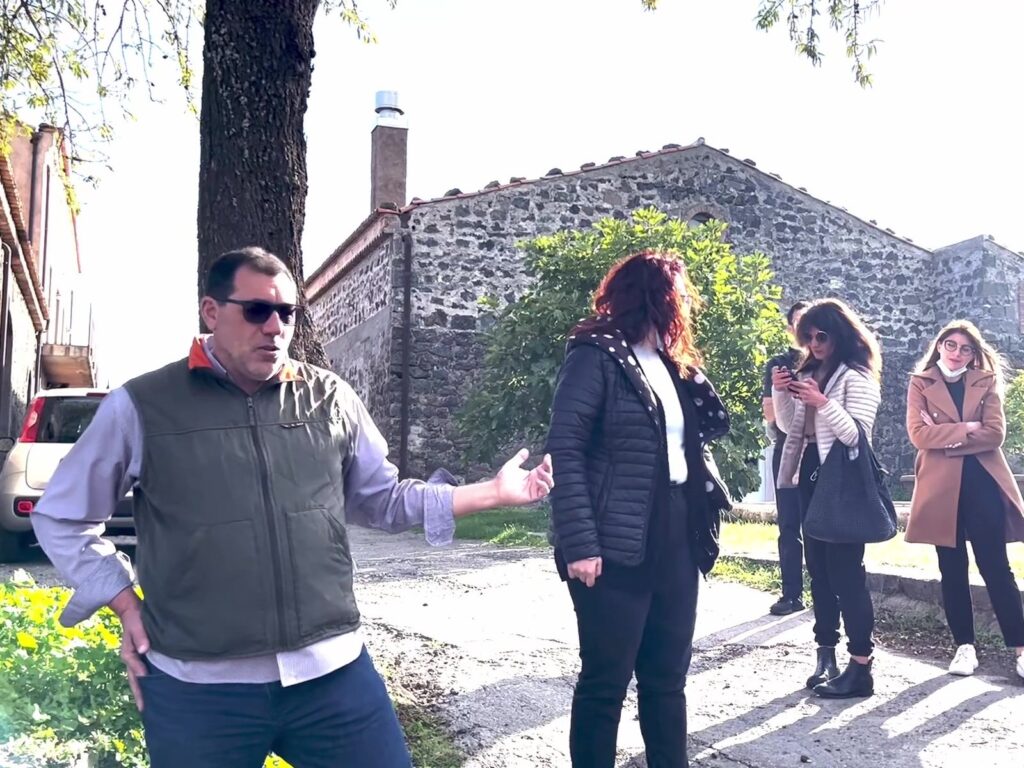
In October 2021 Grape Collective joined a small group at Passopisciaro, Andrea Franchetti’s estate in Contrada Guardiola on the north slope of Mount Etna. Our guide was Vincenzo Lo Mauro, who has been part of the estate since Franchetti arrived on the volcano some twenty years earlier in search of a place to make wine.
We walked the terraces below black stone walls and a ridge of old lava, then moved inside to taste. Vincenzo told the story of an abandoned estate brought back to life, of vines planted so close together the workers thought they were tomatoes, and of how Passopisciaro came to bottle Etna’s contrade, its named vineyard sites, one by one.
Vincenzo spoke in Italian, with an interpreter for the group. What follows is our English translation, edited for length and clarity.
“Why not Etna?”
How did Andrea Franchetti come to Etna?
He came here because of my friend, who was my dentist. He was a great lover of culture, of wine, of this place, someone tied to Passopisciaro and all its vineyards. He was also passionate about jiu-jitsu. At that time a great master came from Japan and was going to Tuscany. Andrea had the same passion, so my friend left Sicily to go up there, and that’s where they met, with this great master.
That’s where it all started. Andrea wanted to do something in the South. He had actually begun a small venture in Calabria, but it didn’t work out. Then, talking about Etna, it was Saro, my friend, who said: “Why not Etna?” It was a chat on a Friday, and by the following Monday Andrea was already here on Etna, searching like a hound after a hare for a place to make wine.
I remember when we first met here. I had planted my own vineyard, and we came to this place, where I used to come hunting. It was a disaster, a real disaster. There were hares, and that was it.
An abandoned estate
At the end of the 1800s it was all planted. There are 39 hectares; take away 10 hectares of lava and the rest was all vineyard, even inside the stream beds, because a torrent runs down through here.
But after several changes of ownership, and also because of the famous lava flow of 1947 that came down, it was completely abandoned. The old owners, seeing the lava coming down 600 metres away, fled in the night, quickly emptying the cellar. It was a slow decline.
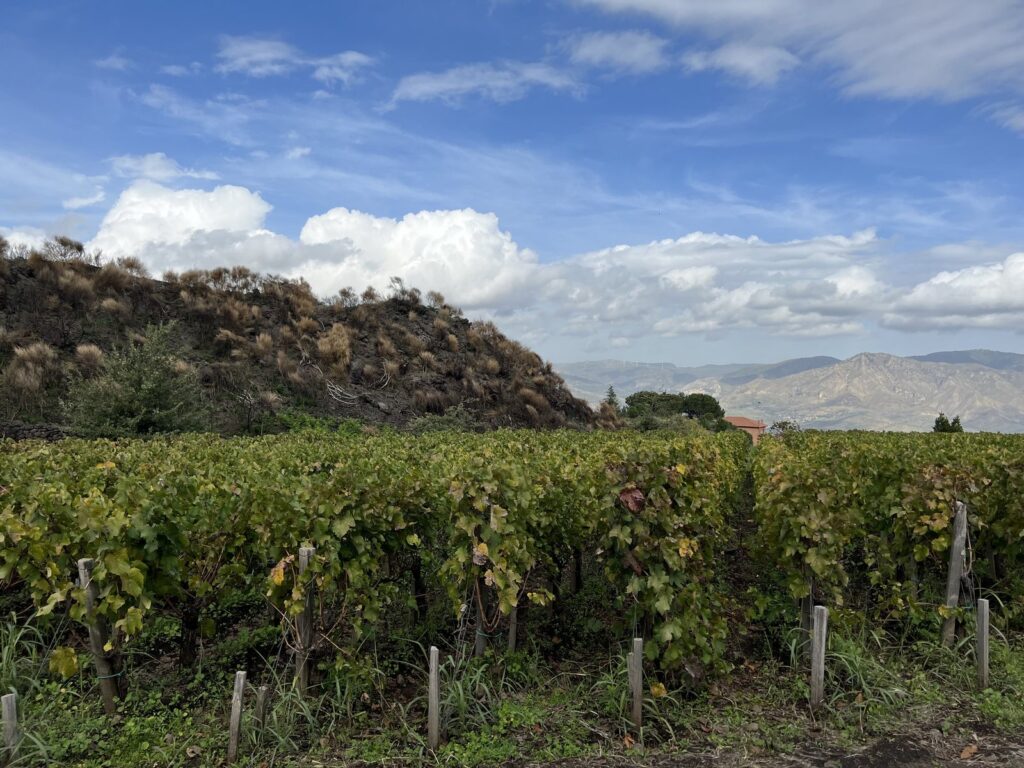
There was just one farmer left who still had his 3,000 or 4,000 square metres of vines. Everyone else had become a builder, a craftsman, a mason, a blacksmith. From the moment Andrea arrived, people began to talk about wine estates again. There were really very few.
A “super wine” and a tomato
Little by little, Andrea had the idea of making a truly great wine, a kind of super wine on Etna. The idea wasn’t so much to plant new Nerello Mascalese, because there was plenty of it. So our work was to plant what he had in mind: some Petit Verdot, some Cesanese d’Affile, partly out of passion, to bring back his Roman roots. In 2002 we started planting Petit Verdot, a little Cesanese and Chardonnay.
Why Chardonnay and not Carricante, for Etna Bianco?
It’s very simple: Andrea Franchetti didn’t like Carricante.
A small team of people came together and we started levelling this land as far as we could, because remember, we are inside a park, the Etna park. Then came this very tight, French-style planting density: one metre by one metre, about 12,300 plants per hectare.
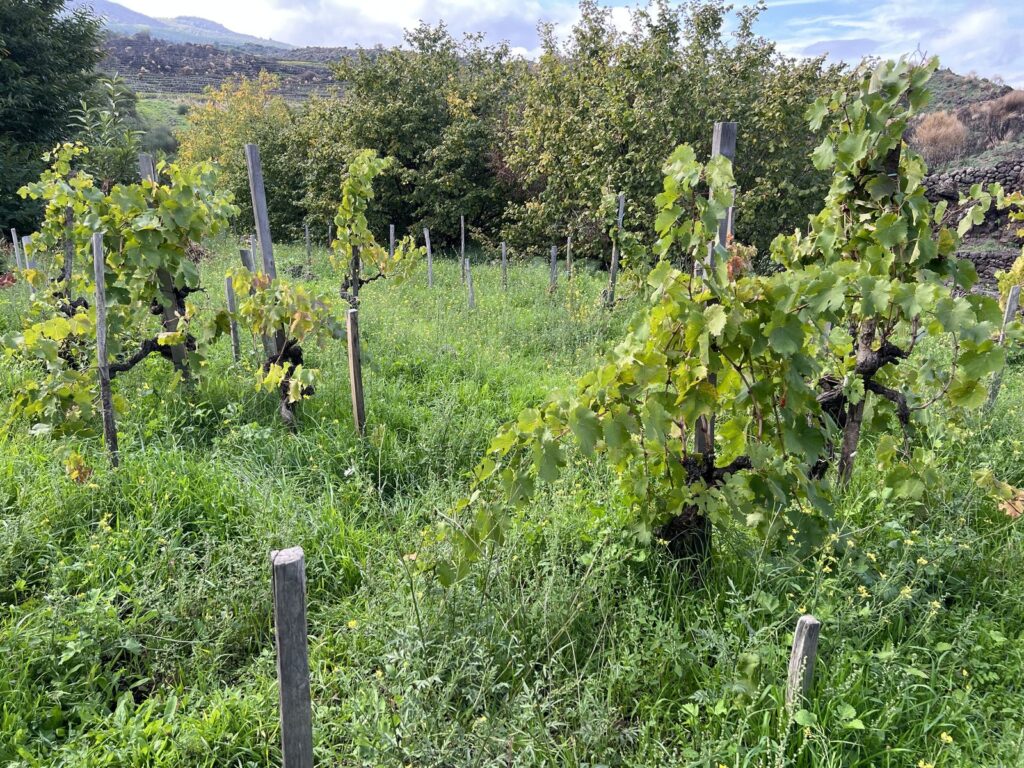
We used to plant with a stake or dig huge holes, because our American rootstock, mostly Ruggeri 140, had roots 60 centimetres long. These new plants were tiny, all compact. We planted them with little forks, and the workers looked at them and said: “What is this, a tomato?”
Now it seems so simple to tell, but back then, believe me, it was as if you suddenly opened your eyes to something that had always been there. In the end it was quite simple. It had always been there; we just never saw it.
The concentration comes from the soil, and from very strict thinning. Imagine: on these plants, in the end, only five small bunches remain. That’s around 400 grams per plant.
Century-old vines and the contrada idea
Then, little by little, another idea came in, the main idea, the one that is still developing: the concept of the contrada wine.
Alongside the viticulture, not overloading the plants, keeping this very short pruning, remember that we found Nerello Mascalese plants barely 60 centimetres tall that were a century old. That’s extraordinary, a priceless inheritance. How does a plant get to be 120 years old? A fantastic climate, Mediterranean, now unfortunately changing but still holding, and very short pruning.
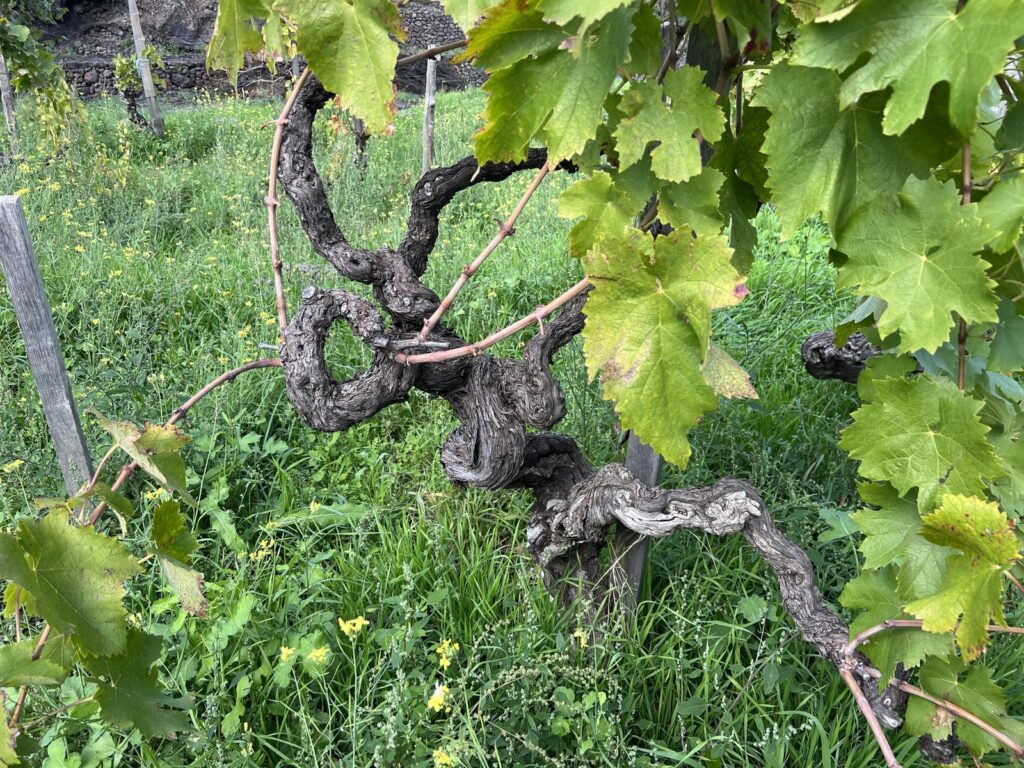
From the 2008 vintage, vinifying each parcel separately in the cellar, we began to think about making contrada wines, because we were picking grapes at 500 metres, 600, 800, up to 1,000 metres, and we noticed different details. The idea was born to put the contrada right into the bottle.
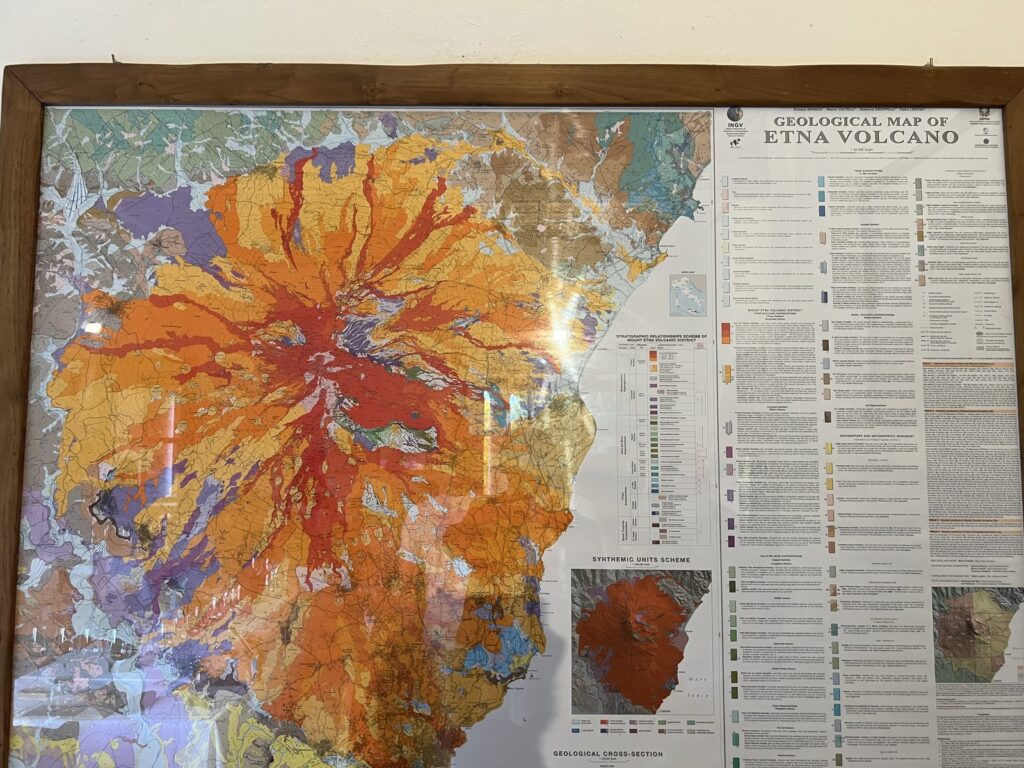
Without wanting to exaggerate, it is like the crus in France. That is the real wealth: managing to find the right word for every single place. And a volcano makes it easier, because volcanic soils are born from different eruptions that overlap and sit side by side, so the elements are always different.
Five contrade, five wines
Over the years we bought vineyards at different altitudes. Each one has its own character. We make five contrada wines, all of them Nerello Mascalese.
Chiappemacchine, about 550 metres. The lowest. In the end it’s a chalky soil, like a blanket, a big mattress of earth over the volcanic rock. The grapes are picked a little later than Porcaria, even though it’s lower, and you get wines that are more approachable, if you like.
Porcaria, about 650 metres. A silty soil. There was a torrent coming down from Etna, carrying everything with it: stones rounded smooth by rolling down. In fact Porcaria may not even exist as a contrada; the official name is Feudo di Mezzo.
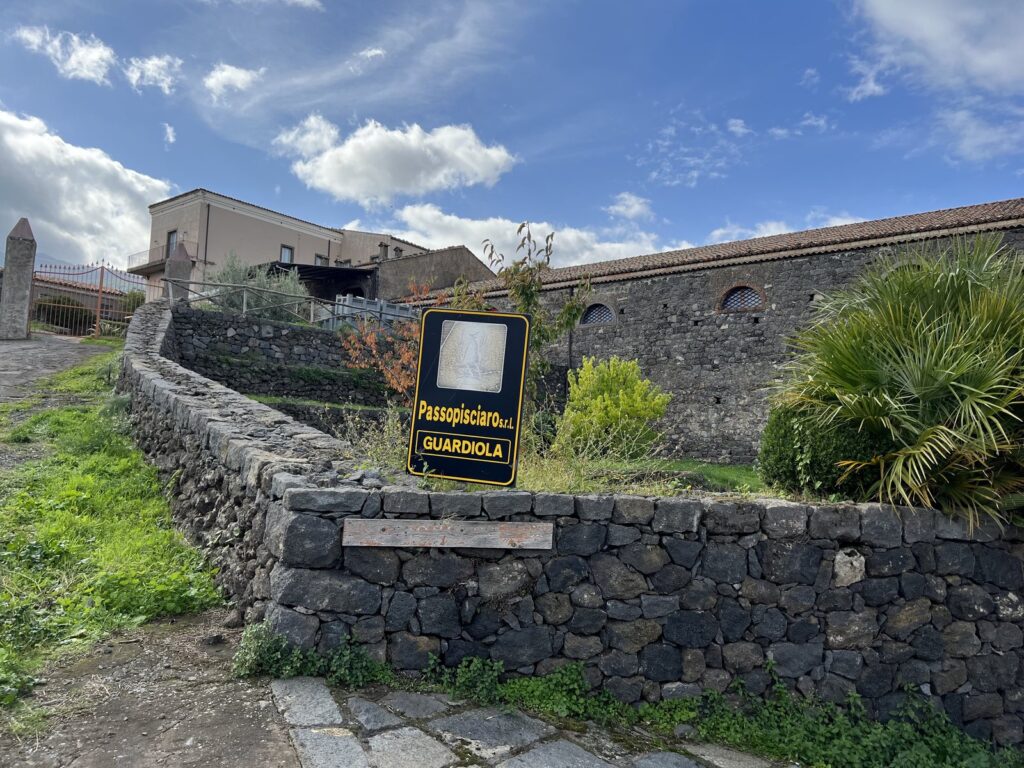
Guardiola, about 800 metres. Where we are now. A very old vineyard of about 7 hectares, among the oldest, from which we pick out a few terraces. The soil is pyroclastic: no lava flow, just this volcanic material.
Sciaranuova, about 800 metres. Move just 200 metres and you find Sciaranuova. Sciara in Sicilian means a lava flow, and this one is new. There’s no soil there, maybe 50 centimetres of earth. Plants like the broom try every way they can to split the basalt. In a way, you feel that strength, that character, in the wine.
Rampante, almost 1,000 metres. Our “dark contrada,” as I call it, because it gets very little sun, so you can harvest really late. I remember the 2014 vintage: we picked on November 17th.
An orchestra, and something more precious than gold
Then there is a single Etna DOC, Passorosso, a blend of contrade of Nerello Mascalese. For me, Passorosso is a great orchestra, playing in my ears, playing my land. They are soloists: no trumpet playing louder than anything else; each instrument plays in its place.
Our top wine, Franchetti, is a blend of Petit Verdot and Cesanese d’Affile, and we make only about 4,000 bottles. People ask, since it costs a certain amount, the classic question: “So, is there gold in this bottle?”
But there is something more precious than gold: sacrifice. The sacrifice of each of us to protect the life of the soil, the life of nature. That’s the most important thing. And transforming all these elements into something liquid, into wine. That is worth more than gold.
Everyone sees it in their own way, but for me it’s really the life behind it, the life of each of us who works and sacrifices, in the vineyard, in sales. It’s all in there.
In practice we don’t use barriques, only for Franchetti, for 4 to 6 months; we buy new barriques about every four years. Everything else goes into large casks and concrete, and the wines stay in the cellar for about 18 months.
Le Contrade dell’Etna, and the farming
Today lots of producers make Nerello Mascalese. Just think: in 2007 we organised an event called Le Contrade dell’Etna. There were 36 producers the first year; recently more than 100 have taken part.
Why do I mention it? Because back then you didn’t know the other producers, didn’t know who they were. It was a way to swap glasses and, back to the contrada idea, to say: “I’m in Contrada Chiappemacchine,” “I’m in Guardiola, right next to you.” It was certainly a way, for everyone, to raise the quality of Etna wine, which, I promise you, was barely drinkable. Today, like anywhere else in the world, there’s friendship, sometimes more than anywhere else.
Is the farming biodynamic or organic?
At the moment we’re not interested in going in that direction. We practise traditional viticulture, meaning we like to do as few treatments as possible: copper and sulphur, biological control against insects such as leafhoppers, and, finally, propolis and rock dust to carry the plants to the end of the season. Everything on the terraces is done by hand, including the harvest.
In the tasting room
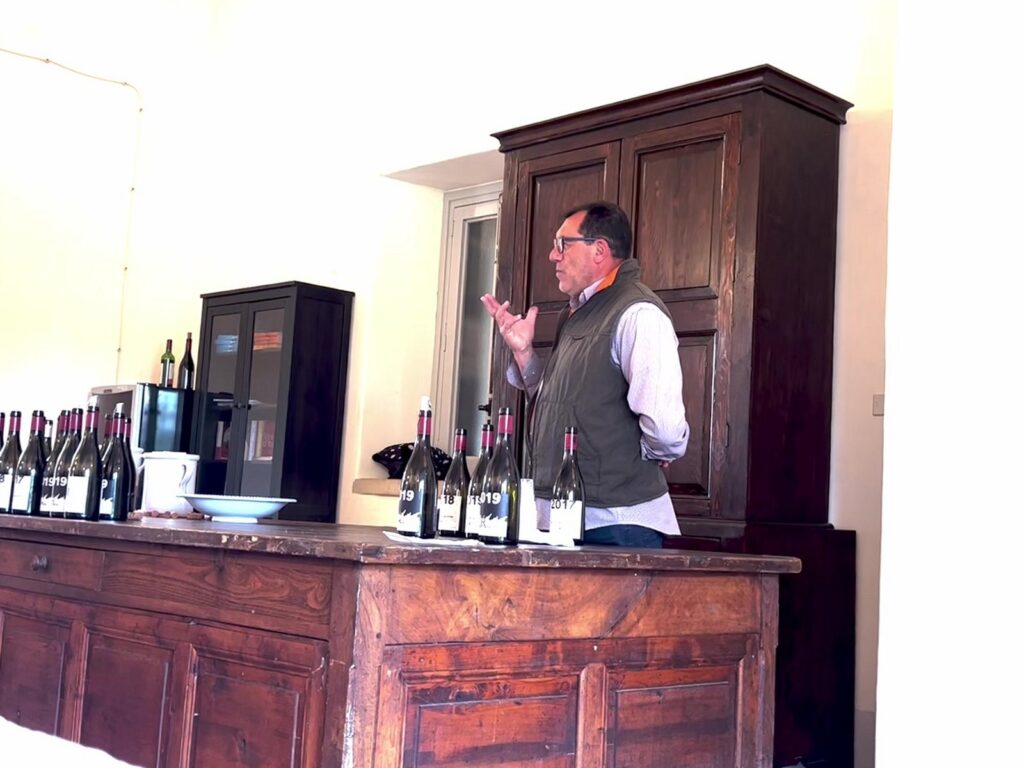
On learning Nerello Mascalese
Up to our first vintage, 2000 and 2001, really no one had ever understood Nerello Mascalese. What is Nerello Mascalese? Until the 2003 vintage we honestly didn’t know what was in our glasses. From 2004 we began to understand and find the road.
Andrea came from Tuscany, where he made muscular, powerful wines. The idea was to carry that over to Etna, with Nerello: that body, those muscles. Totally wrong. Then he understood, also with the help of another great winemaker, that the road was a different one: you had to let it express itself, calmly, without forcing it, and draw it out above all from the pulp, not so much from the skins. The fundamental thing was to get, after a short time, a Nerello true to Etna.
On the contrade in the glass
It’s not only a question of soil, but of climate. When you start to feel more sustained acidity, you understand you’re tasting a higher site. With Rampante you feel the finesse, total finesse. It’s as if you had two blocks, Porcaria and Chiappemacchine below, Sciaranuova and Rampante above, and one in the middle that represents both: Guardiola, which for me is the most complex and the deepest.
People often ask which is my favourite, and I always say Porcaria. I like that more intense colour, the fruit, the roundness.
On Rampante’s terraces
At Rampante I could make four wines. It’s terraced like a staircase. The lower terraces have deeper, richer soil, so the plant is less stressed; at the top it is stressed. People assume that where the plant suffers more you get a better wine. It’s not always true. You find basalt, and two steps further on three metres of earth.
On price
Before, Andrea priced the wines not by the sacrifice but by the density of the wine. The most expensive was Porcaria, because in his view it was the densest. The cheapest, though it really cost us the most to make, was Rampante, because it was the least dense.