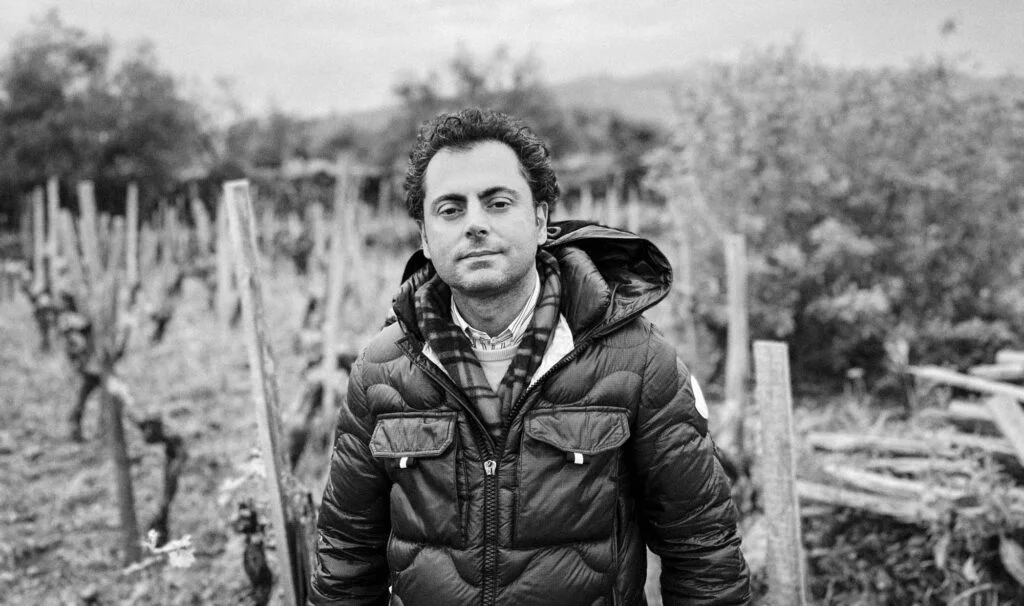
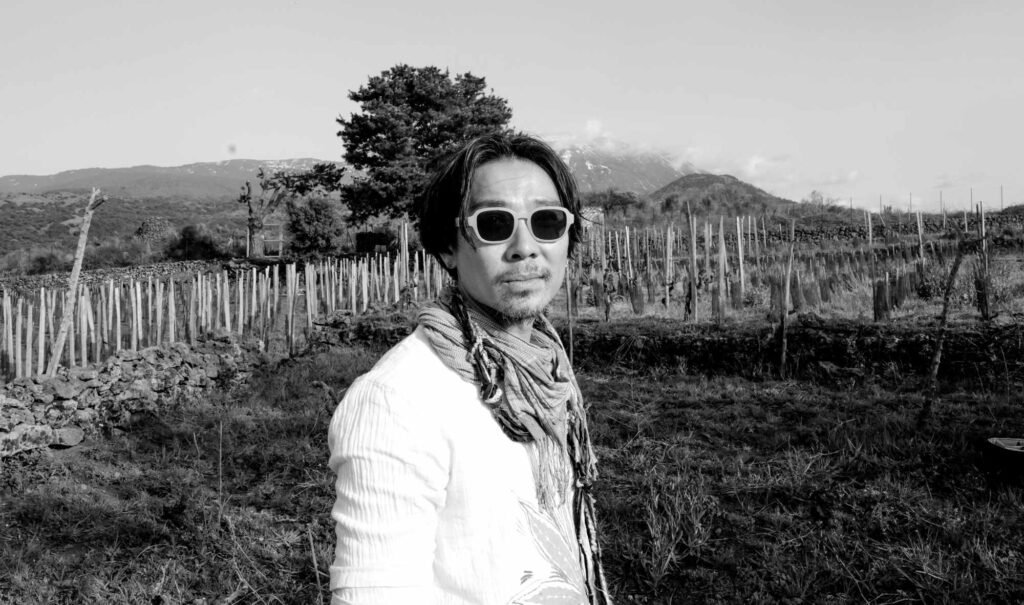
On the northern slope of Mount Etna, in Contrada Santo Spirito, the vines at Palmento Costanzo grow in black volcanic sand between 600 and 800 meters above sea level. Some of them are about 120 years old. They survived the phylloxera epidemic that wiped out most of Europe’s vineyards in the late 19th century because the insect could not reach their roots through the loose, sandy soil. A lava flow from the 1879 eruption runs nearby, a reminder that the ground under the vineyard is still being formed.
The estate began in 2009, when Serena Costanzo’s parents, both from Catania, went looking for a vineyard on the north side of the volcano. The previous owner had sold his grapes to other wineries. The Costanzo family chose to make wine on the property themselves, and to make it inside the old palmento they found there.
A palmento is the traditional stone winery of Etna. It is built into the hillside so that gravity moves the wine. Grapes came in through openings at the top and were crushed by foot on the upper level, the pista. The juice flowed down to a second level, where it fermented on its own. The finished wine then went down again to age in chestnut casks. Palmenti were once common across the mountain, but most fell out of use as winemaking modernized. The Costanzos restored theirs with care. They brought new equipment in through the roof and built tanks inside, while keeping the original structure and its gravity flow. They named the winery after it.
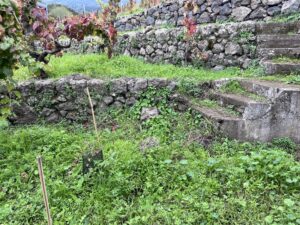
The family’s approach has not changed since the start. They work only with Etna’s native grapes: Nerello Mascalese and a small amount of Nerello Cappuccio for the reds, and Carricante with a little Catarratto for the whites. The goal is wine that speaks of a single place. The vineyards are farmed organically, with no herbicides or synthetic pesticides. The old vines are planted in the quincunx pattern of traditional Etna viticulture, on terraces that have been worked by hand for generations. There is no irrigation, so the roots grow deep in search of water. Instead of adding fertilizer, the estate sows grasses and legumes after harvest to add nitrogen and organic matter to the thin volcanic soil.
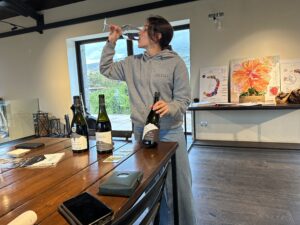
Serena grew up in Catania with Etna in view. Locals call the volcano Mamma Etna, and she speaks of it the way one might speak of a family member. Her grandmother used to tell her that the mountain’s shape changed every day. Visitors who hear the rumble of an eruption are often frightened. For the people who live on its slopes, it is part of ordinary life.
Winemaking on Etna goes back to the Greeks and Romans, but its modern reputation is recent. For a long time, Nerello Mascalese was shipped north to add body to wines made elsewhere in Italy and in France. Only in the last few decades has a new generation of producers come back to the volcano with modern knowledge and equipment. Etna is now one of Italy’s most closely watched wine regions. It is often compared to Burgundy because its wines change from one contrada, or cru, to the next.
That level of detail is where Serena puts much of her attention. She studies the differences between contrade, and within a single contrada down to individual terraces, using small experimental batches called micro-vinifications. We spoke with her at the estate about the history of the palmento, the four elements that shape Etna’s terroir, and her hopes for the region’s future. The interview has been edited for clarity.
Tell us about the history of the estate.
The history of our estate, Palmento Costanzo, began in 2009, when my mother and father started looking for a vineyard here on the northern slopes of Mount Etna. They found this one in the Etna DOC area, in Contrada Santo Spirito, where we are between 600 and 800 meters above sea level.
The previous owner used to sell his grapes. With my parents, the winery was born, and they began making wine inside the palmento. The vineyard is very old, with vines as much as 120 years old, because phylloxera was never able to reach the roots. That is why we have these very old vines. We grow only native varieties. When my parents came here, they found a vineyard planted entirely with native grapes: Nerello Mascalese and a small percentage of Nerello Cappuccio. They decided to keep going in that direction, with a very clear idea of Etna wine built on Nerello Mascalese and Nerello Cappuccio.
A few years later, they found another vineyard nearby, also in Contrada Santo Spirito, planted with a blend of Etna’s white varieties: Carricante and a small percentage of Catarratto. From the beginning, our idea was to produce very territorial wines. We want them to represent Contrada Santo Spirito, where we are, and the volcanic soil, because we are on the slopes of an active volcano, Etna.
What is your philosophy of viticulture and winemaking?
At Palmento Costanzo, and especially in Contrada Santo Spirito, where most of our vineyards are, our philosophy is to focus on the traditional viticulture of Etna. This vineyard is planted in the quincunx system. Each vine is one meter from the next, and the vines are arranged in triangles. The old farmers of Etna used this system because of the terrain, which is why you see so many terraces here. It also lets the vines draw water from deep in the soil, which matters because we don’t irrigate on Etna. And it means each vine gets sunlight throughout the day. It is the traditional way of growing vines on Etna.
You don’t use herbicides or pesticides?
No. From the beginning, our idea was to stay close to the traditions of Etna and to make elegant wines with a strong mineral character, which comes from the volcanic soil. We farm organically, so we don’t use chemical pesticides or other chemical products, only the treatments allowed in organic farming. I always say that for us, the most important thing is to understand what each vine really needs. We pay attention to every vine, and we walk the vineyard every day to check for fungal disease and on the vines’ general health.
For the same reason, we don’t follow a fixed schedule for vineyard work, including fertilizing. Normally we don’t fertilize at all. Instead we use green manure: after harvest, we sow grasses and legumes between the rows to add nitrogen to the soil. The soil on Etna is sandy, and on these slopes especially it has very little organic matter, so we try to build it up with this kind of natural fertilizing.
Tell us about Etna’s terroir: the volcanic soil, the altitude, the old vines, the climate.
Etna has a very special terroir because it has been shaped by so many lava eruptions. Near our vineyard there is a lava flow from 1879, and we are between 600 and 800 meters. I sometimes explain Etna’s terroir through the four natural elements.
Air, because Etna is always influenced by winds from the sea. Fire, because Etna is an active volcano, and we see eruptions nearly every month. Water, because we don’t irrigate on Etna. We can’t, so the roots go deep into the soil for water and nutrients. And earth, the last element: the land we work every day.
That is what makes Etna so special. It is also why the area is divided into different slopes: the north, the southeast and the southwest. Each one is very different from the others in soil and altitude. On the southeast and southwest slopes, for example, vines can be grown up to 1,000 meters. The sea matters too, since the southeast slope faces it directly. All of these factors make Etna’s terroir unique.
For people who don’t know Etna, tell us about the volcano itself. It is the most active volcano in Europe, and yet people live on it every day, making wine and farming.
Etna’s history goes back 500,000 years, so it is a very long history. My parents and I are from Catania, and every day we wake up and see the volcano. It is a special sight every day, because it always looks different. My grandmother used to tell me that Etna’s shape changes every day. The volcano is always changing.
Sometimes wine lovers who come to visit hear the noise of an eruption, the explosions, and they are very frightened. For us it is normal, even a special moment. We feel so close to the volcano that we call it Mamma Etna. For us it is like a grandmother, or a mother. Every time we come here, every time we look out the window and see the volcano, we feel something very powerful. I think it is in the blood of the Sicilians who live near the volcano.
Unlike a region such as Piedmont, which is largely a monoculture, Etna has a real diversity of crops: pistachios, lemons, oranges, olives. It’s almost a Mediterranean garden on a volcano. Talk about that diversity.
The variety of crops on Etna is very interesting. Pistachios are grown here, especially on the slopes around Bronte. And, as everywhere in Sicily, there are lemons, oranges and much more. All of these crops make this territory very rich in biodiversity.
Marco de Grazia told us that Etna makes you know your limits, that you are a small part of something much bigger. How do you see that?
Yes, Etna makes us know our limits. But that is the most important thing for us, because every day we try to understand better what those limits are and where they lie, and how we can work within them. That is how we keep finding different ways to reach, in the end, a clear and worthwhile goal.
More broadly, I hope all the producers on Etna can be ambassadors for Etna’s winemaking culture and carry it around the world. And I hope every wine lover who discovers Etna wine will come here to see this special terroir for themselves.
Talk about the place of Etna wine in history. The Greeks made wine here, and it has been an important region throughout the history of Sicily and Italy.
Yes, winemaking on Etna is very, very old. It began with the Greeks and Romans, who came here and saw that the area had great potential for wine. Then vine growing stopped for a long time, and it was only centuries later, in the 18th century, that Etna was rediscovered for wine. In that period, Nerello Mascalese was sent to northern Italy and to France to be blended with other important varieties, such as Nebbiolo and Pinot Noir. So at first, Nerello Mascalese was not considered an important variety. Then, over the last 30 years, producers began to rediscover this territory with new knowledge and new technology, and we started making high-quality Etna wine again.
What is a palmento?
Palmenti are the buildings where farmers made wine using the old traditional method. At harvest, they put the grapes in small boxes and passed them through the palmento’s two windows onto the first level, called the pista. There the grapes were usually crushed by foot.
The juice then went down to the second level, where fermentation began on its own. Once the wine was ready, it went down to the aging area on the third level, where the old Etna winemakers aged it in chestnut wood.
When we arrived in this contrada and found the palmento, we began restoring it carefully. We wanted to keep making wine inside it with modern equipment while still respecting the gravity system. Today the grapes arrive on the first level, where we sort them by hand at a table. Fermentation then begins in wooden vats and tanks, and when the wine is ready it goes down to the aging area on the third level.
Why did your family name the winery after the palmento?
From the beginning, we understood how important the palmento is to the tradition of Etna winemaking. That is why we chose to call our winery Palmento Costanzo.
Finding a palmento on our property meant a great deal to us. From the start, we wanted to respect the traditions of Etna wine, and our dream was to keep making wine inside it using the traditional system. At the same time, we wanted to move forward and use modern technology, but always with respect for the palmento. The original structure was kept exactly as it was. Everything inside it now was brought in through the roof, and some tanks were built right inside. For us, making wine in a palmento in 2024 is very special, and a great opportunity to carry that tradition forward with modern tools.
The main grapes here are Nerello Mascalese and Carricante. Marco de Grazia has called Etna the Burgundy of the Mediterranean. Talk about the wines made here, their quality and how well they age.
Etna wine is made mainly from native varieties: Nerello Mascalese and Nerello Cappuccio for the reds, and Carricante and Catarratto for the whites. Native varieties grow best where they come from. That is why Etna focuses on them. They best express the volcanic soil and the terroir.
Nerello Mascalese and Carricante are especially interesting because they age so well. That comes from their minerality and acidity, and in the case of Nerello Mascalese, its tannins. These qualities are what let the two varieties develop in the bottle. They express the volcanic soil, and their ability to age makes them stand out in the world of wine. That is why our winery focuses on these two grapes. They best match the style of wine we have wanted from the beginning, with elegance, acidity and the ability to age, and they best express the Etna terroir.
Wine appears in the Odyssey, and it has long been an important part of the culture of Sicily, and of Etna in particular. Talk about what wine means to people here.
The emotional bond Sicilians have with Etna wine comes from the nature of Etna itself. The fact that it is an active volcano, and that you can make wine on its slopes, is what I think moves us most. The wine culture of the people who live on those slopes grows out of that. Everyone who lives near Etna has a family history tied to this land. Their parents or grandparents probably had a small plot that they farmed every day in the traditional Etna way. It is fascinating to hear these people talk about the old methods, because they know this land extremely well, especially when it comes to growing vines.
Growth has its good and bad sides. Marco de Grazia and Frank Cornelissen have both talked about wanting Etna to become like Piedmont, and also not wanting that. What are your hopes and concerns for Etna’s future?
In the last 20 years, Etna’s volcanic wines have become very well known, and the region keeps growing. New producers arrive all the time. I hope we can all grow together and stay connected, even with different styles. It is very interesting that every producer has their own idea of Etna wine and their own philosophy of winemaking. But I think we can keep growing while staying close to one another, respecting and promoting the land, and serving as ambassadors for Etna’s winemaking culture around the world. I hope wine lovers everywhere will come here to discover this place.
Earlier you mentioned your family’s relationship with the volcano. Can you say more about that?
My mother passed her love for this special place on to me. I grew up seeing her work here every day, walking in the vineyard and looking at Etna. She was born in Catania, and like everyone in Catania, she loves Etna and likes to go up on weekends for day trips. So does my father. They passed this love on to us, and mine grows every day as I work here and watch these grapes grow in this unusual terroir. Etna is also called the island within the island because its terroir is so distinctive. Seeing it every day makes me love it more and want to learn more, because it is always changing. The volcano changes so much that sometimes we call it crazy. But I think that is what keeps us focused, every day, on the volcano and on growing vines here.
Is there anything we haven’t covered that you’d like to add?
Etna’s terroir is very special, and I think we need to keep studying the differences between the slopes. But there are also big differences within a single contrada. We talk a lot about Etna’s contrade and how each one differs from the others. At Palmento Costanzo, we want to understand the differences between contrade, and also the differences within one contrada, and we study them every day. Walking in the vineyard, we always notice that one terrace is different from the next, and the grapes from each terrace reach the cellar with those differences. So we keep studying our land every day, tasting, and making micro-vinifications to understand these differences better.