There was a grape producer in Burgundy who said a thing that I think was very wise. He said, “Pinot Noir is not a great grape. Pinot Noir is a great grape in Burgundy.” So Nerello is not a great grape. It’s a great grape on Etna. Outside of Etna, it doesn’t deliver. I’m not saying that Pinot Noir doesn’t deliver outside of Burgundy, but I haven’t ever tasted a Pinot Noir outside of Burgundy that can compare with great Pinot Noirs of Burgundy.
So the great appellation is the best place for its variety. Otherwise, people would be planting Cabernet in Burgundy and Pinot Noir and Bordeaux and so on and so forth. And it wouldn’t work. So I think the best thing about Nerello Mascalese is that it took whatever it took, centuries and centuries or millennia, to find the right grape.
And it’s not the only grape, because there’s also Nerello Cappuccio, there’s Nerello Mantellato, there’s some … They used to mix in some white grapes with the red. And in the old vines, you still find them. There are wines that like solitude, grapes that like solitude. There are wines and grapes that like company and enjoy company. And Nerello Mascalese is just the right grape for Etna, for red wines, just like Carricante is the right grape for white wines here. Then you can add a little bit of this and that that’s been added here for forever and ever.
But comparing it with another grape, that doesn’t really make much sense to me. Yes, I can say that, for me, it is the similarities between Nerello. There’s a kinship between Nerello, Pinot Noir and Nebbiolo. There’s some kind of kinship there. How, I don’t know.
If you taste them separately, one reminds you of the other. If you taste them together, you see how different they are, but that they share something ineffable, but that’s there. It’s like two brothers or two sisters. Sometimes they don’t really look alike, but you can tell they’re brothers or sisters. It’s something like that.
Marco, tell me a little bit about how you discovered the Etna wine region.
I first came down here at the end of 1998 or in 1999, I can’t remember exactly which. At the time I had a wine distribution company in Florence, and we were very popular in the ’90s. Basically, I was a truffle hunter for wine. I would travel around Italy searching out little estates that could make extraordinary wines, and sometimes I would help them improve. Because of that, vignerons came looking for us, and one of them was the owner of an estate on Etna. He came up to Florence to offer me his wines, so I went down to see whether the estate belonged in my portfolio.
In the end I didn’t take on the estate. Instead, I stayed, rented a car with some friends and traveled around Etna, tasting wine in cafés and in the homes of small vignerons. It was house wine that was never going to be bottled. But discovering wineries, and discovering new places or old, forgotten ones, was my job. When I tasted these wines, I was struck by their finesse and their potential. They were also the type of wine I like.
My favorite wines were those of the Langhe in Piedmont and those of Burgundy. Here I felt not only that there was the potential to make very fine wine, but that it was the kind of wine I loved, something close to those wines in character. And the prices were right. I couldn’t afford much at the time, but prices here were very reasonable. So I bought a piece of land with a house, more of a summer home, with a small vineyard. I found someone to look after the vineyard and someone else with a cellar where I could make the wine. That’s how it started.
Eventually I ran into problems, both with the upkeep of the vineyard and with making wine in somebody else’s cellar. I had to decide whether to make the leap, build my own cellar and expand the property, or drop the whole thing. I chose the first, and in 2002 I made my first wine. On the back label, and it is still there today, I boldly stated that Etna was the Burgundy of the Mediterranean. In 2002 that was a big statement. Today, many people describe Etna that way.
That first wine was also already a cru: Guardiola 2002, with Guardiola on the label. In 2003 I made Guardiola and Calderara. In 2004, Guardiola, Calderara and Feudo di Mezzo. Unfortunately, I then ran into the anti-fraud authorities, whose director had unearthed a tiny legal issue. The appellation rules allowed sub-zones, but a 1991 ministry ruling said you couldn’t use them unless each one was named in the appellation documents. Obviously, when the DOC was created in 1968, nobody was going to list the 190 or so different crus, or contrade, that existed.
So we fought over it. For three or four years my wines were impounded every year. I would pay the fine, they would release the wines, and I would sell them. Finally, in 2005, I was able to make them understand that putting the vineyard name on the label was actually beneficial, because it gave them more control against fraud. From then on I could do it legally, and little by little the contrade were approved by the Ministry of Agriculture, in 2011 I believe.
That was the beginning of the single vineyards, which now virtually everybody uses to identify where their grapes or vineyards are from. And that should define, as it does in Burgundy and the Langhe, a type of wine with its own identity. This matters. It mattered in the past, when wine was sold in bulk: I found some old notebooks showing that wines from different contrade were priced differently when they were shipped down to the port. It matters in the present, and it will matter much more as time goes on and the areas become even more specific.

What was the wine landscape like on Etna at the time, in terms of reputation and the number of people making quality wine?
There were very few people making wine, let alone quality wine. Maybe four, five, perhaps six estates were bottling wine, and that was it. The area was virtually abandoned, which was different from what I had found in Piedmont in the ’80s. There, over 90% of the production was sold as grapes or bulk wine to co-ops and négociants, but the vineyards were well kept. They weren’t abandoned. Here, an enormous number of vineyards had been completely abandoned, and only some of the old folks still kept their small vineyards going. Little by little over the last 20 years, and especially the last 10, the landscape has changed dramatically. Hundreds and hundreds of hectares have been replanted.
One of the problems, which I’m sure you have heard elsewhere, is that in Piedmont the knowledge of how to maintain vineyards was never lost. Here, we lost a few generations to emigration, which was huge. So even today it is much harder to find someone who knows how to work a vineyard than to find an agronomist. Putting together a skilled team is difficult, and one of the things I’m proudest of is the exceptional team we have built over the years.
You mentioned Burgundy. What is it about Etna’s terroir that makes it so distinctive and allows it to produce such distinctive wines from different areas?
The terroir here is completely different. It isn’t really a geological terroir, defined by differences in the subsoil. It is an endless series of lava flows, each one different from the next, that have repeatedly covered the volcano and created different soils as they flowed down. Then there are the differences in altitude. This is probably the only appellation that allows a 600-meter difference between its lowest and highest points. In Chianti it’s maybe 250 meters. In the Langhe, maybe 200, not more. Here, even 50 meters makes a difference, so 600 makes an enormous one. Our vineyards range from 400 meters above sea level up to 1,000 meters.
The climate also varies completely. For instance, the east side, around Milo, was formed differently. It is a side of the volcano that collapsed in on itself, which created a completely different terroir, and the climate there is different too. So what Etna shares with the Langhe and Burgundy is an enormous variety of terroirs, climats, altitudes and exposures, as the appellation wraps around the volcano like a half moon, stretching for many kilometers. It has all the subtleties of Burgundy.
But the similarity goes beyond that. It is also the character of the wine: the pale color, the finesse, the delicacy, the particular drinkability when young and the wonderful way it ages. Very few wines of that caliber are drinkable right away and also age well. Burgundy has that privilege, and so does Etna.
Let’s talk a little about the culture here. Sicily has been invaded by the Greeks, the Romans, the Normans, the Spanish and the French, and the Arabs sprinkled a bit of their essence into what became Sicily and Etna. I see the wine community here reflecting that to some extent: you have people like Salvo Foti, who has been here a long time, but also people like yourself or Frank Cornelissen from Belgium. How does Sicily’s multiculturalism show up in today’s wine community?
Multiculturalism is extremely important to Sicily’s culture as a whole, but you can roughly divide the island into Eastern and Western Sicily. Western Sicily was more profoundly Arab. It is very close to Tunisia: from the island of Pantelleria you can see the lighthouse on Cape Bon, about 40 nautical miles away. The Carthaginians, the Tunisians and the Arabs in general took all of Sicily, but their deepest influence was in the west. Eastern Sicily was more Greek.
As a result, vineyards were planted much more on the Greek side. In the museum at the foot of Etna, you find Greek coins stamped with grape clusters and Dionysian figures. This area was very strongly influenced by the Greeks, and they were the ones who built viticulture here, just as they did in Campania, around Naples: high-altitude vineyards, volcanic soils, late-ripening varieties. When the Romans arrived, they found a viticultural foundation that was already Greek.
But do I think that history influences who comes here now? I doubt it. What has happened here has also happened in Tuscany, in Piedmont and in many other parts of Italy, and in France too. Go to almost any famous wine region, Burgundy for example, and you will find people from all over the world, just as you do here, each with a completely different history. So I don’t think the layers of Phoenicians, Arabs, Greeks, Spaniards, Swabians, Normans and so on explain why foreigners want to make Etna wine. I think wine is an inspiring liquid, and it carries that enthusiasm around the world. If you think about it, there aren’t many things people cross an ocean for, other than art, wine or a vacation. Wine is one of them. And once you fall in love with a type of wine, you may want to try making it yourself.
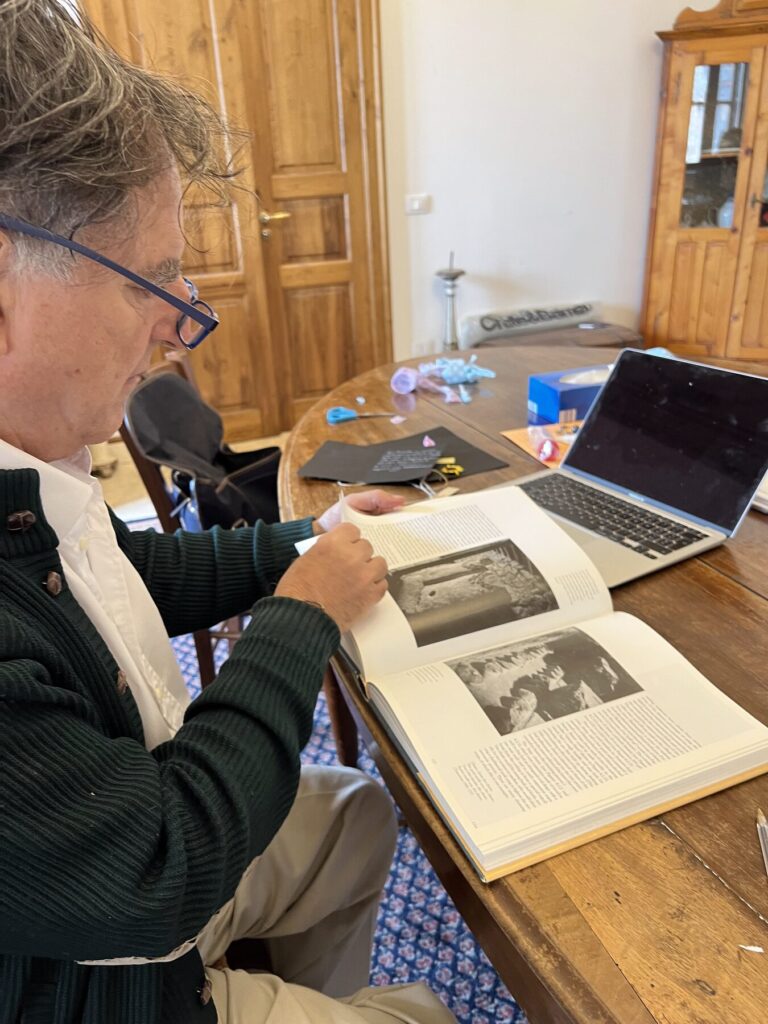
Marco de Grazia with a book on Armenia at Terre Nere. Photo: Grape Collective.
Marco, you studied philosophy, is that correct?
I graduated in comparative literature, Greek and theater. Philosophy too, of course, since it is part of the Greek heritage.
Has that affected the way you think about wine?
Of course, but it’s a complicated subject. To simplify, there is the so-called Socratic method. Socrates asked questions and called himself a midwife. Through his questions, he drew answers, or at least thought processes, out of people. He wanted to make people think, and to do that he had to draw things out of them, never put things into them.
I think there are two types of winemaking. In the first, you put things in: you make a wine shaped by your own character and personality. In the second, you act as a midwife. You try to express what the vineyard gives, to ask the vineyard the right questions so that it can express itself. You treat it in the best way possible and let it speak. That is why I chose to make single-vineyard wines from the beginning; otherwise there would be no point. My winemaking is simply that: drawing out the vineyard’s potential, its character and personality, and putting it in the bottle.
Fantastic. In your interview for the film Barolo Boys, I think you said, “I’m helping a new territory. I already see the seeds of glory, and at the same time, the future disintegration.” That’s a very interesting way of looking at the landscape here. Could you talk a little about that?
It is. The seeds of glory are obvious in Barolo, and they are obvious here now too. Today there are wines from Etna that anybody would be proud to make, and that glory is clearly growing. At the same time, history shows that there are ups and downs. This goes back to my studies, but it is clear to anyone with some common sense, educated or not, that history moves in cycles.
So even as you see the glory, you can already perceive in it the seeds of a later period of decadence: a period of confusion, when the questions being asked will miss the point, and when people will come just for the prestige of owning something here, not because they care about the territory or the terroir. You can see that happening. You also see many people who are confused and don’t know exactly what they are looking for. But that is part of human nature, part of how things unfold over time.
I think Salvo Foti said, “There are people who make Etna wine, and there are people who make wine on Etna.” Is that a fair statement in relation to what you just said?
Yes, I think that’s fair. Indeed, it puts it in a nutshell. Within that nutshell there are a million different ways of doing things, but it is essentially true.
Maybe talk about the emotional attraction of Etna.
The emotional attraction of Etna is really no different from the emotional attraction of any great wine you love. Let me make a short aside, if I may. When I was studying Greek, the class was divided into students who preferred Aristotle and students who preferred Plato. You were on one side or the other, which is fine. Then, out of college and into life, I began to notice that people, whether or not they had read Plato or Aristotle or even heard of them, still fell into one of those two categories. In the Western world, the influence of these two great philosophers is that immense.
Then, suddenly, I was in the world of wine, and there were two categories there too. In France, you are either a Bordeaux lover or a Burgundy lover. In Italy, you are either a Piedmont lover or a Tuscany lover. And oddly enough, if you were a Bordeaux lover, you were an Aristotelian, no doubt about it. If you were a Burgundy lover, you were a Platonist. The same goes for Italy. These loves carry the same power. Depending on who you are, you love in different ways and you love different things, and I don’t think it is any different on Etna. Your drive comes from what you love.
What you learn over time goes in every direction. One thing you learn is your limits, but you also learn that your limits are part of the beauty of it. For instance, I have learned that I no longer care about vintages. A great winemaker friend of mine once said he no longer even knew what a great vintage was, and I feel the same way. I think every vintage is there for our joy, our entertainment, our happiness, our pleasure, for the different pleasures each one offers. They are not really a limitation; in a way they are a bonus.
I have also learned that if you work ethically, with great care and great passion, every vintage will deliver something beautiful. That is a wonderful thing to learn. Of course, if a hailstorm destroys your harvest, there is nothing you can do. But short of something that dramatic, a very fine terroir will always deliver something fine.
Looking back on the modernist era in Barolo, what are your thoughts on it now?
Looking back, it was a revolution, and we knew we were doing something very important. We had no idea how important it would become. It wasn’t simply about new barrels, as most people say. It was about being much more organic in the vineyards, producing much less, and dropping fruit when necessary. Sometimes we had to do that at night, because people thought we were crazy. Some producers had huge problems with their mothers and fathers over it. The generation gap was incredible and painful in many ways. It was an attempt to put Barolo and Barbaresco on the world map as great wines.
Once again, we took Burgundy as our example. We saw that it was possible to make a Barolo that was gentler than before, more sharply defined, and at the same time more substantial. We were seen as a threat, and to understand why, you have to realize it was a question of survival. After the war, Italy was in very bad shape, especially its agriculture and viticulture. Piedmont was extremely poor; you can’t imagine how poor. As soon as synthetic fertilizers and systemic sprays appeared in the ’50s and ’60s, everyone used them, because they allowed growers to produce a lot of grapes that wouldn’t rot.
It was about survival. The growers didn’t even get to set the price of their grapes. Nobody wanted Nebbiolo. When I was there, from the early ’80s to the mid-’90s, Nebbiolo grapes for Barolo or Barbaresco cost less than Dolcetto grapes. If you bought five cases of Dolcetto, they would give you a case of Barolo for free. That was the reality. So growers had to overcrop to survive, and most of the grapes were sold off anyway.
What we were doing went against the grain: using different barrels, cleaning up the cellars, trying to make sharply defined wines, and producing less to get more substance. If a wine is going to age, it needs substance. It doesn’t have to be big, that was never the point. We weren’t looking for big wines; we were looking for fine wines, and you can’t get those if you overcrop. It involved many different steps, and we learned as we went.
I am still very proud of that. If Barolo now enjoys worldwide recognition, a lot of the credit goes to the producers, the little guys I worked with, who followed me around the world promoting their wines. Of course we made mistakes. Everybody does. The only people who never make mistakes are the ones who never do anything. You learn from your mistakes and you keep getting better.
And I applied the same approach here. Terre Nere, my estate here, has been organic since 2002, our first vintage. I used the same practices, very short pruning and everything else we did in Barolo, adapted of course to the very different climate here. In their own way, all of those lessons were applied here. So that era was very important for many reasons: for Barolo and Barbaresco, for the producers themselves, for me, and for what I was able to do here.
Following on from that, let’s talk about the climate here. I was told that something like 60% of producers farm organically. Compared with Piedmont, which has a more challenging climate, you seem to have conditions here that favor organic viticulture. There is also less monoculture, with many different fruits and vegetables, which makes for a completely different landscape than Piedmont.
Let’s take those one at a time. First, organic farming. I’m not at all sure our climate is better for organic viticulture than Piedmont’s. We have everything here: oidium, mildew, you name it. Remember, this is an island within the island of Sicily, a huge volcano. It rains five times as much here as in the rest of Sicily, and there is one little town where it rains ten times as much, so much that you can’t even make red wine there. So I’m not convinced this climate is easier than Piedmont’s. In certain areas, I’m sure it is more difficult.
Second, I don’t know what percentage of producers here are organic, but everyone should understand that until the ’50s, the entire world was organic. There was no choice. So it isn’t impossible, and it isn’t that hard. It is simply a matter of not forgetting what we once knew, or of recapturing it. That is the real truth. You can farm organically virtually anywhere. Sometimes you pay a small price for it, but if you are really careful, not even that. When a harvest is very rainy and rot sets in, nothing can stop it. Organic farming is preventive. Once you have caught a cold, there is no aspirin to take, so you want to avoid catching the cold.
I’m working on sustainability for the consortium. Right now I’m trying to arrange a contract with one of the organic certification bodies to work with the whole consortium, so that the small producers can afford certification. The process is very complicated, costly and requires technical help, and the very small growers can’t afford it unless we negotiate a collective contract. That is what I’m working on, and I think we’ll have it by the end of the year. It will mean that everyone who wants to be seriously organic, and is willing to be tested by certifying bodies, will be able to do so. Organic is the only future, here or anywhere else. Sometimes you have to take one step back to take two steps forward.
Fantastic. What about the diversity of plant life on Etna?
Here again, it isn’t so different from Piedmont 40 years ago. Back then, in Piedmont, people planted whatever they liked, peaches, poplars and so on, in spots that were unlikely or impossible for grapes. We have the same thing here, but we went through a longer period of decline. For instance, there was no such thing as an olive grove on Etna. Olive trees were planted around the vineyards, where the vines ended, so you could have olive oil with your wine: the two basic elements of the Mediterranean, along with bread. Piedmont, in a way, is no longer Mediterranean. It’s too far north for the olive tree.
One difference in the landscape here that I forgot to mention is the lava. After a lava flow, like the one in 1981, it takes 300 or 400 years for the lava to break down into plantable soil. There is nothing like that anywhere else. So the terroirs here actually change, though not in a way you or I will see in our lifetime. In a few hundred years, the area buried by lava will become a new terroir, and nobody will know what it is like until it exists. That is an interesting way of looking at things.
The landscape obviously changes that way. But I believe that in another 20 years, so many more vineyards will be planted that nearly all the plantable land will be vineyards, with olive trees around them and a few fruit trees here and there. Everybody likes to have some. We have six or seven cherry trees, apricot trees and so on. They don’t take up much of the land; they’re just there so we have fruit to eat. I think that will remain the case everywhere.
And you’re making honey now.
Yes, we’re making honey. It is part of our sustainability project, and it is very important to us. We produce it and sell it at cost, and the people who buy it resell it at their cost. It is a way of showing how important bees are, and how important it is to keep them healthy in an organic world, because they are dying by the millions. Last year in Italy, honey production crashed by 95%. That was due not only to pollution, insecticides and the like, which is bad enough, but also to the weather. In the north it rained during flowering, and here it didn’t rain for four months, so the flowers burned and the poor bees had to be fed. We have to be very careful. Bees are extraordinary creatures, and they produce an extraordinary thing, honey, which has been part of our lives for thousands of years. They are also sentinels of our health and of the health of the places we live. That is why this matters to us.
What is your view of some of the traditional practices on Etna, particularly the alberello and the palmento?
The alberello is a very important way of growing vines. Until tractors came along, every vineyard throughout the Mediterranean was trained as alberello, no question about it. It matters most, obviously, on steep hillsides and terraces, where tractors still can’t go today. It is a wonderful way of growing vines. If you look out the window, you can see my alberello vines right up on the terraces.
Interestingly, to replant those alberello vines, I had to remove fruit and olive trees. Every so often the wine world goes through a crisis, and there were several here. During those times, people replaced vines with fruit trees, because vines take an enormous amount of labor and olive trees don’t. On terraces the work is much harder, since you can’t use a tractor. You have to work by hand or with a small walk-behind tractor. Those were the first vineyards to be abandoned, because they were too expensive to farm and the price of the grapes couldn’t cover the cost.
So the alberello is definitely a good way of growing grapes. On the other hand, on flat land there is no problem using Guyot or any other training system you like.
And the palmento? Does it still have a future, or is it part of Etna’s past?
It has a future. The palmento is a very sophisticated version of the lagar. I was talking the other day with a young Portuguese woman from the Douro, the port region, and trying to explain the difference between our three-level palmento and the single-level lagares they have there. It is a sophisticated, ancient way of making wine, and it works perfectly well. Nothing can be said against it except one thing: you can’t make much wine in the space it takes up. With tanks of any kind, you need much less room. If a palmento lets you make, say, 50 hectoliters of wine, the same space with tanks lets you make 200 hectoliters or more. That is the difference.
In many ways, though, the palmento is ideal. It offers a very large, open surface for fermentation, so the oxygen the yeasts need to convert sugar into alcohol is readily available. In a more closed tank, there is less of it. Treading the grapes by foot, or turning the cap by hand, is gentler than pumping over. And moving the wine down by gravity is also very good, because it is the least damaging, the least manipulation possible. In some very old palmenti, which are large and quite rare but still exist, the wine flows by gravity from the last level straight into the barrels.
So if a small producer buys a small vineyard that comes with its own palmento, that works absolutely fine. I have at least five palmenti on my property. I recently restored one, and there wasn’t much to do because it was solid. I basically just repainted the walls, and now it is there for everyone to see. It was in use right up until I bought the property. Many palmenti are still used today and are perfectly functional. If you have a small property and want to use one, perfect, no problem at all. It depends on how much wine you need to make to make it work.
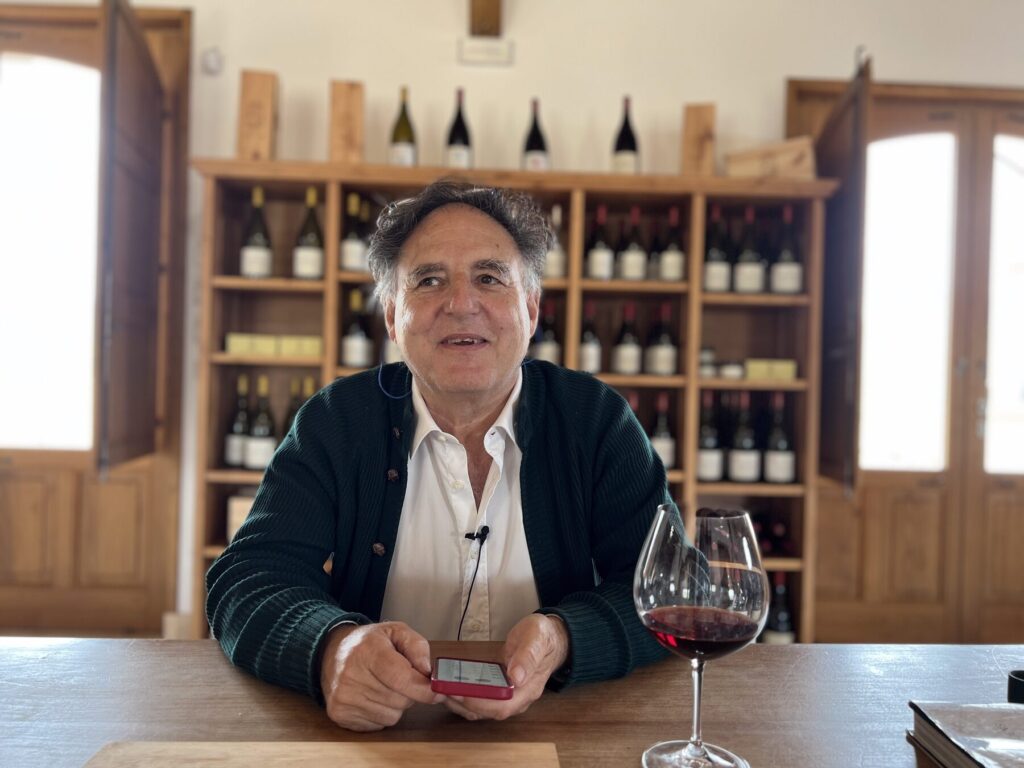
Marco de Grazia tasting in the estate’s cellar door. Photo: Grape Collective.
Perfect, thank you. Nerello Mascalese is the key grape on Etna. How would you compare it to the great grapes of the world?
A grower in Burgundy once said something I think is very wise: “Pinot Noir is not a great grape. Pinot Noir is a great grape in Burgundy.” In the same way, Nerello is not a great grape. It is a great grape on Etna. Outside of Etna, it doesn’t deliver. I’m not saying Pinot Noir never delivers outside Burgundy, but I have never tasted one from elsewhere that compares with the great Pinot Noirs of Burgundy. A great appellation is the best place for its variety. Otherwise, people would be planting Cabernet in Burgundy and Pinot Noir in Bordeaux, and it wouldn’t work. So the best thing about Nerello Mascalese is that it took whatever it took, centuries or millennia, to find the right grape for this place.
And it isn’t the only grape. There is also Nerello Cappuccio and Nerello Mantellato, and growers used to mix some white grapes in with the red, which you still find in the old vineyards. Some grapes like solitude; others enjoy company. Nerello Mascalese is simply the right grape for red wine on Etna, just as Carricante is the right grape for white wine here. You can add a little of this or that, as has always been done here.
But comparing it with other grapes doesn’t make much sense to me. What I can say is that there is a kinship between Nerello, Pinot Noir and Nebbiolo. How, I don’t know. If you taste them separately, one reminds you of the other. If you taste them side by side, you see how different they are, yet they share something ineffable that is definitely there. It’s like two brothers or two sisters: sometimes they don’t look much alike, but you can tell they’re siblings.
Last question: what are your hopes for the future of Etna?
My personal challenge is to keep improving our red wines as much as possible, but there is a limit to how much we can improve them. I have less experience with white wines, so I think there is more room for improvement there. Right now, I have a particularly keen interest in what can be done with whites in the different areas, and I can’t wait to see it.
For instance, I planted a vineyard in Milo, and I can’t wait to get its grapes. I also planted a vineyard in the highest part of Calderara, and this will be its first year of production. I know the grapes will be great, and I think they will improve the Calderara Bianco we already make, which I already love. We also have new vineyards coming into production in San Lorenzo and Calderara, and in time they will improve our red wines as well. So yes, making our wines as fine as possible is what I’m after.
Marco, is there anything I haven’t asked that you would like to add?
One thing that is interesting: you mentioned many people coming here from different countries. Now they are also coming from Italy, from the north. They are coming to invest from Barolo and from Tuscany. Just the other day I heard that a Tuscan company had bought in.
Tommasi just bought in, too.
Yes, Tommasi from the Veneto bought in as well. Companies are coming in from all over to buy. Obviously there is a reason for that. If you want to know how many columns there are in St. Peter’s, don’t ask a Roman, ask a tourist. The Roman lives there. He breathes it and sees it every morning, so he doesn’t bother to count. Sometimes outsiders have a more objective view. They have distance, and they are interested in the details. They come, take a look, and fall in love or see the potential. I hope that is one of the reasons so many people are coming.
I hope it isn’t just about economics, because it is very difficult to make wine here, and making good wine is even harder. Going back to the idea of revolution, there is a great film by Gillo Pontecorvo, The Battle of Algiers, about the fight to take Algiers back from the French. In one scene, I can’t remember the exact words, two revolutionaries are on a rooftop at night. One of them is all excited about the revolution, and the wiser one tells him that it is very difficult to start a revolution, and even more difficult to win it, but that the truly difficult part begins after you have won, when you have to rebuild.
It is the same here. You start a revolution, and then the hard part begins: keeping it from falling apart. So people who come here need to understand that. They have to want to build on what has been done. That is what matters. If they come with that in mind, with that attitude and that strength, boy, are they welcome.