Opens in a new tab

Eduardo Torres Acosta

Est.

2013

500-1000m

Elevation

 alberello

VINE TRAINING
Appellation: 

Etna DOC

Eduardo Torres Acosta on Making Volcanic Wines in the Canary Islands and Mount Etna

Christopher Barnes

Eduardo Torres Acosta grew up on Tenerife, the largest of the Canary Islands, a Spanish archipelago off the coast of northwestern Africa. As a child he made wine with his father and grandfather on his family’s small vineyard plot. In 2012 Eduardo moved to Sicily and worked for two of Italy’s most respected wineries, Azienda Arianna Occhipinti and Azienda Passopisciaro. Eduardo is very literally a garage winemaker, making wines from a group of eight small parcels on Etna in a garage he converted into a winery. He makes natural wines using traditional Etnean viticulture, and his vineyards are mixed plantings of various local varieties: Nerello Mascalese with Nerello Cappuccio, Alicante, Garnacha, Minella, Catarratto, Grecanico, Carricante and Inzolia. Grape Collective talks to Eduardo about this unique wine journey and the magic of making wine on Etna.

Eduardo Torres Acosta on Making Natural Wine on Etna

Eduardo Torres Acosta belongs to the generation that turned Mount Etna from an afterthought into one of Italy’s most closely watched wine regions, and he got there the way many of Etna’s best growers did: from somewhere else. He grew up on Tenerife, in the Canary Islands, making bulk wine with his father and grandfather on the family’s small plot. He studied agricultural engineering, then oenology, and in 2012 a friend suggested he try a harvest in Sicily. He came for one vintage, saw Etna, and stayed.
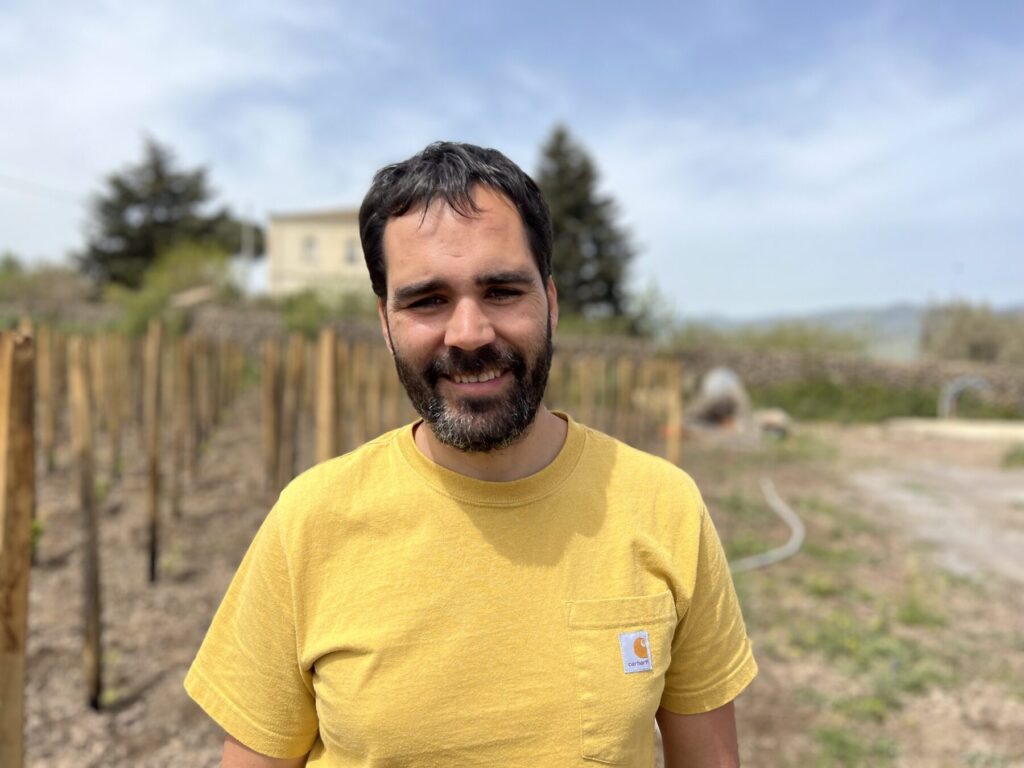
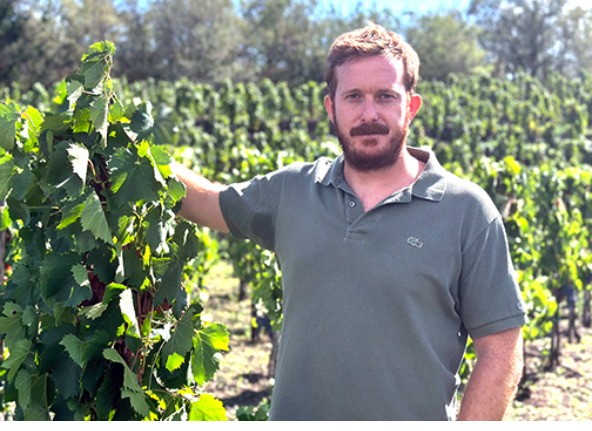
Eduardo Torres Acosta in his vineyard on Mount Etna
Eduardo Torres Acosta in his vineyard on the north slope of Etna. Photo: Grape Collective.

That immigrant’s eye matters. Etna in the early 2000s was a region in retreat. Old terraced vineyards had been abandoned because the grapes were worth almost nothing, and the people who saw what was still standing there, ungrafted old vines, mixed field blends, alberello training on chestnut stakes, tended to be outsiders: Andrea Franchetti, Frank Cornelissen, Marco de Grazia. Torres Acosta arrived a decade later, worked with Arianna Occhipinti and then as an oenologist at Passopisciaro, and learned the mountain contrada by contrada. What he recognized on Etna was something he already knew from home: volcanic soil, high altitude, hand labor on terraces, the palmento, and the pine-and-chestnut carpentry of a pre-industrial cellar. He is less a foreigner adapting to Etna than a volcanic islander finding a second island. The natural wine part matters just as much. He farms without recipes, rents and buys old parcels rather than clearing and replanting them, keeps the olive and cherry trees standing among the vines, maintains the dry-stone walls, and replants with massal selections taken from the vines already in the ground. In the cellar he accompanies the fermentation rather than directing it. Etna’s revival could easily have become a land rush for prestige. Growers like Torres Acosta are the reason it also became a restoration.

Eduardo, how did you end up on Etna?

I arrived in Sicily in 2012. I am originally from the Canary Islands. First I studied agricultural engineering, then oenology. At home I worked with my parents and my grandfather, and we made wine, bulk wine. While I was studying oenology, a friend, the producer Roberto Santana of Envínate, suggested I come to Sicily, to Arianna Occhipinti. I stayed for the 2012 harvest, and that is when I met Etna. From that year on, I wanted to come back and make a vintage here, to get to know the terroir and the varieties and to look for the things Etna and the Canary Islands have in common, because both are volcanic. So in 2013 I started looking for a winery where I could work a harvest, and Passopisciaro, Andrea Franchetti’s estate, offered me a job as oenologist that year. I started looking for vines to farm and learning as much as I could. With him I learned a great deal about the contrade and the different vineyards, and that is why I am still here.

What was it that pulled you in?

Etna itself. The volcano, which is still active. The soil. The chance to farm at high altitude, in small parcels. You can go from 500 meters to 1,000 meters in ten or twenty minutes by car, and you can feel the difference between one zone and another: different microclimates, different rainfall, different wind, different everything. I like working vineyards in several zones, because each vineyard expresses a different idea. In larger, flatter regions you don’t find those differences.

Why do you think Etna attracted people from outside, and what was the region like when they arrived?

Part of it is simply that Etna is a place people come to. It is the Mediterranean: there is the sea, the sun, the beautiful weather. And then this particular corner of Sicily has the volcano. Think of the people who came around 2001, Frank Cornelissen, Marco de Grazia, Andrea Franchetti. None of them are originally from Sicily. It was a depressed area then. There were established wineries, Benanti, and Calabretta up in the north, but there was no movement. The land had been abandoned, because grapes were worth nothing. So when people from the wine world arrived and found this soil, these indigenous varieties, these old vines and this traditional way of growing them, they fell in love with the place. That is what happened to me when I got here in 2012. I wanted to make wine here immediately, however small the job, because what interested me was getting to know a volcanic terroir like the one I came from.

What did you recognize from the Canary Islands?

The vineyard has always been the thing that ties it all together, and here it sits in a spectacular place with a very particular soil. In the Canary Islands the volcanic soil changes enormously depending on where you are, and it is the same here: soils that look related but are completely different from one another. I was also drawn by the beauty of the place and by the polyculture, the fact that there are many other plants among the vines, unlike so much of Italy, where you find monoculture. And the techniques mattered to me. The old palmento exists in the Canary Islands too, and the system is more or less the same. The training system, the alberello, is something I have really only seen here, in Etna and elsewhere in Sicily, with old vines trained to a chestnut stake. You only find that chestnut stake here on Etna. There are other places, Noto for example, with their own traditional systems, but the alberello caught my attention.

The main difference is that in the Canary Islands the system is more archaic, and here it is more professional. You see it in the old palmento: there is the window where the grapes come in, and then the work happens level by level. The upper part is where the grapes arrive and are trodden by foot, below that is the old press, and below that the aging. I think you can see the French influence, and the influence of northern Italy, in how it was built. It was more modern than what I knew. The Canary Islands were Portuguese, Genoese and Spanish in turn, and that influenced how we make wine, but there we use parts of the pine tree, while on Etna the palmento is built with volcanic stone.
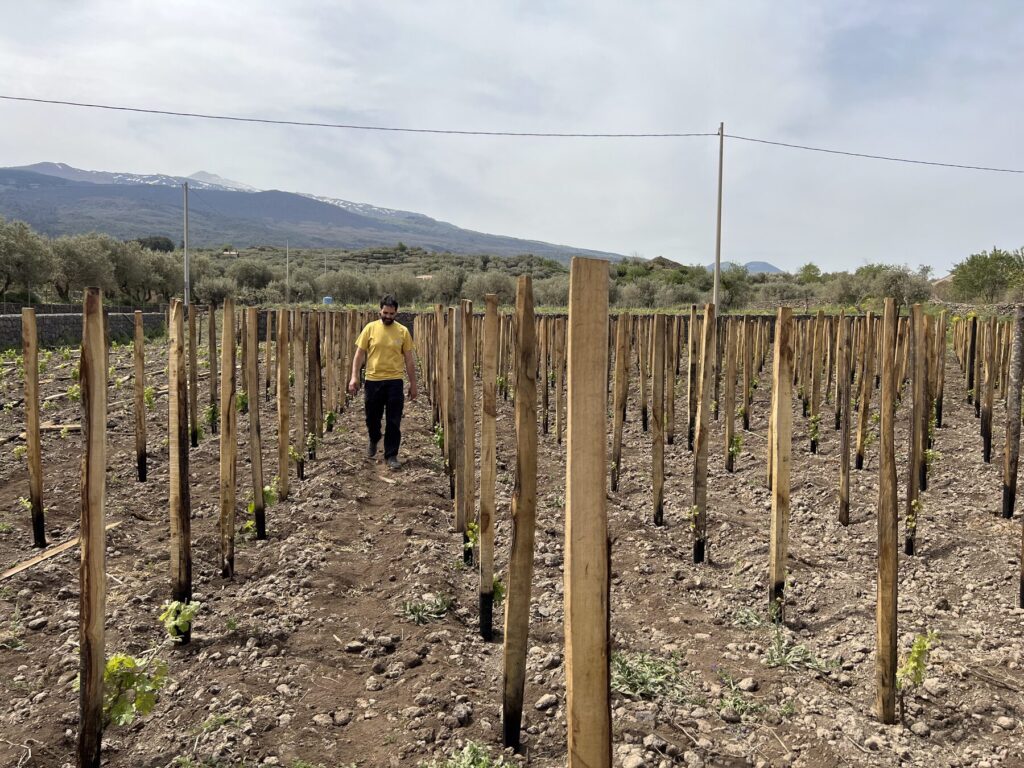
Vineyard rows below Mount Etna at Eduardo Torres Acosta estate
Vines below the summit on Etna’s north slope. Photo: Grape Collective.

Talk about the terroir of the north slope, where you work.

Our part of the north runs roughly between Randazzo and Linguaglossa. You have to understand that the north side of Etna is a kind of channel, and the air that moves through it changes everything, depending on which direction it comes from. Normally the wind comes from the west. When it comes from the southeast it is a warmer wind. The soils were created over a very long time, millions of years and many eruptions. Some come from lava flows, and some from pyroclastic eruptions, where the volcanic material was carried by the wind and covered a whole part of the territory. That covered land is what we can farm. Where the lava flows are, it is stone, and you can’t cultivate there at all. Near those flows people gathered the stones and built the terraces. All of this changes depending on the zone. In some places the soils are very fine and deep, and they give wines that are more floral, more fruity, a little broader. As you climb, you find soils with much more skeleton, more stone, and those wines are more direct, more spicy. It also depends a lot on the altitude. Our lowest vines are at 550 to 600 meters, and there the Nerello skins are a bit thicker and the tannin is more direct. As you go up, the skins are finer and the wines gain in finesse and elegance. That difference in altitude and in soil is what makes the terroirs so different in the end, even though it is always volcanic.

You farm organically. Was that a decision you made when you arrived, or something you brought with you?

I brought it with me. When I worked in the Canary Islands, in the traditional way, we were always essentially an organic culture. When I arrived on Etna it was the same idea: what you do in one place, you cannot do in another. We work in several different vineyards, in different zones, and each one changes the way you farm it. For me the first thing is to respect the varieties that are already there. Over these years we have recovered the old vines I was able to rent, we bought two vineyards and we planted a new one. In all of these old vineyards we kept the varieties that were growing in them. Where vines were missing, we did a massal selection and planted cuttings from the same plants, so we have the same clones and the same varieties as the old vines around them.

For me that matters: respecting the tradition, and respecting the soils. It also means keeping the dry-stone walls, farming in a way that is sustainable for the environment, and leaving things alone. If there is an olive tree, keep the olive tree. If there are cherry trees in the middle of the vineyard, keep the cherry trees. Keep it as a farm, the way it was farmed here before. I think this diversity, this whole ecology, is important for the product we make.
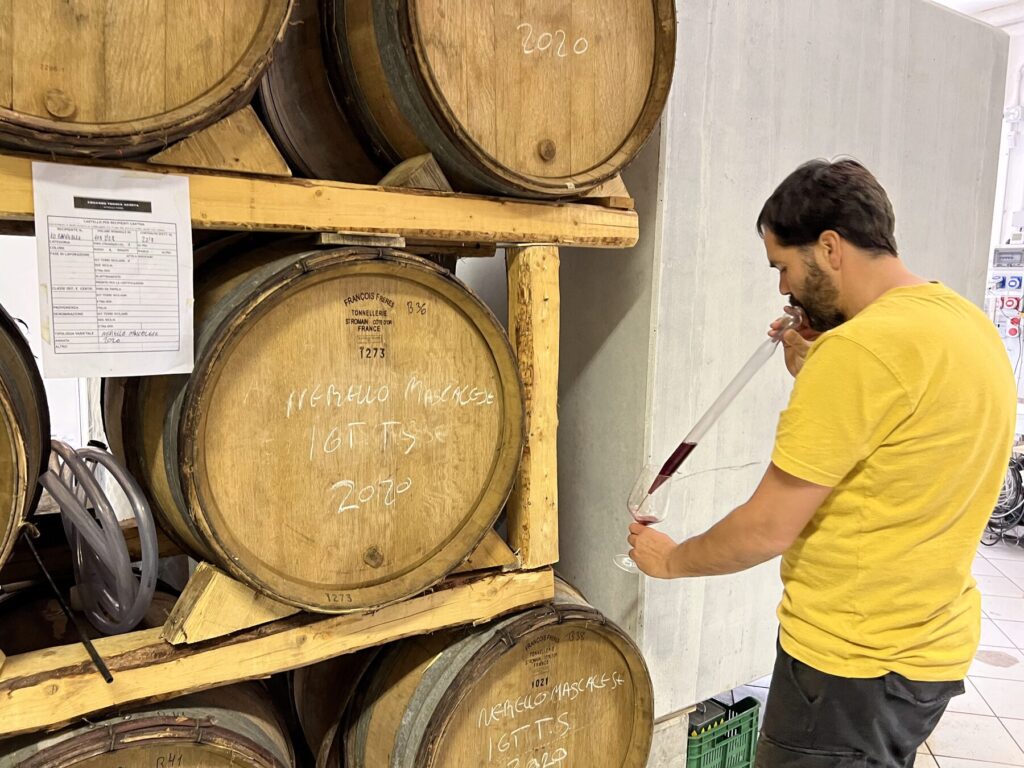
Eduardo Torres Acosta drawing wine from a barrel in his cellar
Drawing a sample from barrel in the cellar. Photo: Grape Collective.

What is your philosophy in the vineyard and in the cellar?

Respect what you find in the vineyard and reproduce it: keep the varieties, keep the clones, replace what is missing, respect the old vines. Then bring the fruit into the cellar and simply accompany the fermentation. In general we don’t intervene, because what arrives is good enough. You also have to understand that the climate in Sicily is very good. Viticulture here is simple, at least on the north side. The east side is more complicated, because it is more humid. The north is well ventilated: last year we did almost nothing beyond a sulfur treatment. On the east side we had to treat more. That is what I mean when I say the vineyards change, and that they change the wine you make. I don’t do the same thing in a vineyard at 500 meters that I do at Nave, which is at 1,000 to 1,100 meters. I do different things, because I want to interpret each vineyard and put what it tells me into the wine.

Why does the alberello matter so much to you?

The alberello is a traditional system that has been used here for many generations. It is important for the landscape, and it is important for the ecology of the place: the chestnut stakes come from the woods around Etna, and we take them and use them in the vineyard. The practical reason is that we don’t have large expanses of land on Etna. We have terraces, and everything was once done by hand. The alberello was the simplest way to keep the canopy ventilated and in the sun. On smaller terraces you could arrange the vines and still get in to work them. It is a lot of hand work, but the traditional planting, 1.2 by 1.2 meters, gives you a lot of vines. In the 1800s and the early 1900s, when the wine trade here was at its height, almost everything was planted to alberello, and it was planted for quantity, because the growers and the owners wanted volume of must to sell. That is why you find big palmenti all the way from the lowest part of the slope up to 1,100 meters. So the alberello is a system that can produce quantity. You can regulate the crop depending on how much you leave, and the more you leave, the more vegetation you get. It is a beautiful way to grow vines, but you have to know how to work it.

And the palmento? Does it still matter?

It is wonderful to find them here, because I don’t think you find them in many other places anymore. There are still farmers who have their vineyard and their palmento. I know a producer, now making his own wine with his family, a local family, who used to make bulk wine, and their palmento was shared between three families. They would agree among themselves on who brought in their grapes first, second and third, each with a short window to use it. If you look at how it was set up, with no machinery at all, it was very well thought out. In those days there were no pumps, nothing. Everything was manual, so they built on the slope and worked with the levels: the must went down into the vats, and then down again to the pressing below. It is beautiful to have that history and to keep it. The same goes for the old vineyards. We have to respect them, not destroy them to make big terraces.
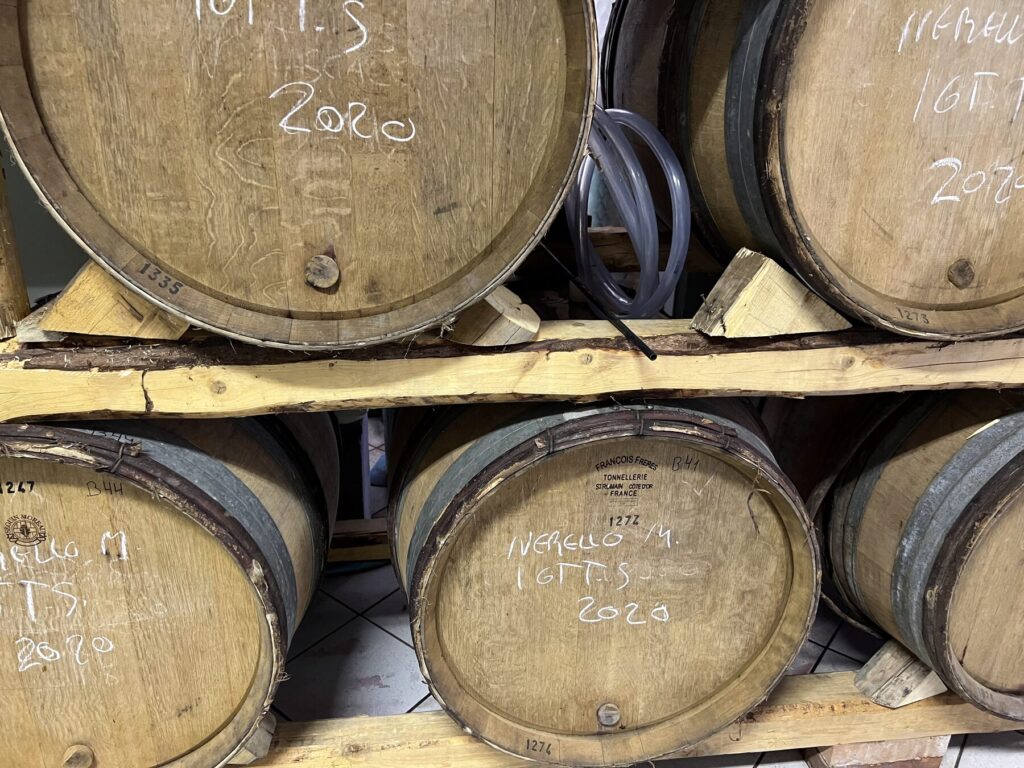
Barrels of Nerello Mascalese marked in chalk in the cellar
Nerello Mascalese in barrel, marked in chalk by vintage. Photo: Grape Collective.

Nerello Mascalese is the great grape here. What does it mean to you?

When I arrived I got to know Nerello Mascalese, which is the queen of the north slope. If you go to another part of Etna, the east side, you find a lot of Carricante, the white grape, and the same is true in the south, where there is more sun. When I came to Sicily and discovered Etna, Nerello Mascalese was one of the reasons I wanted to stay here, farm vines and make wine. When I arrived on the north side, I would say 90 to 95% of the old vineyards were Nerello: 85 or 90% Nerello, mixed in with other varieties, including white grapes, all planted together. For me it is a beautiful variety, with a long cycle and a good deal of resistance, in the way it ripens and in its skins. I start picking Nerello in the lower zone at the end of September and finish in the highest part at the end of October. That is almost a month, with one variety, which tells you how much the altitude shapes it. But it always gives the wine a character that I sometimes find similar to certain varieties in the Canary Islands, and I think that comes from the volcanic soil.
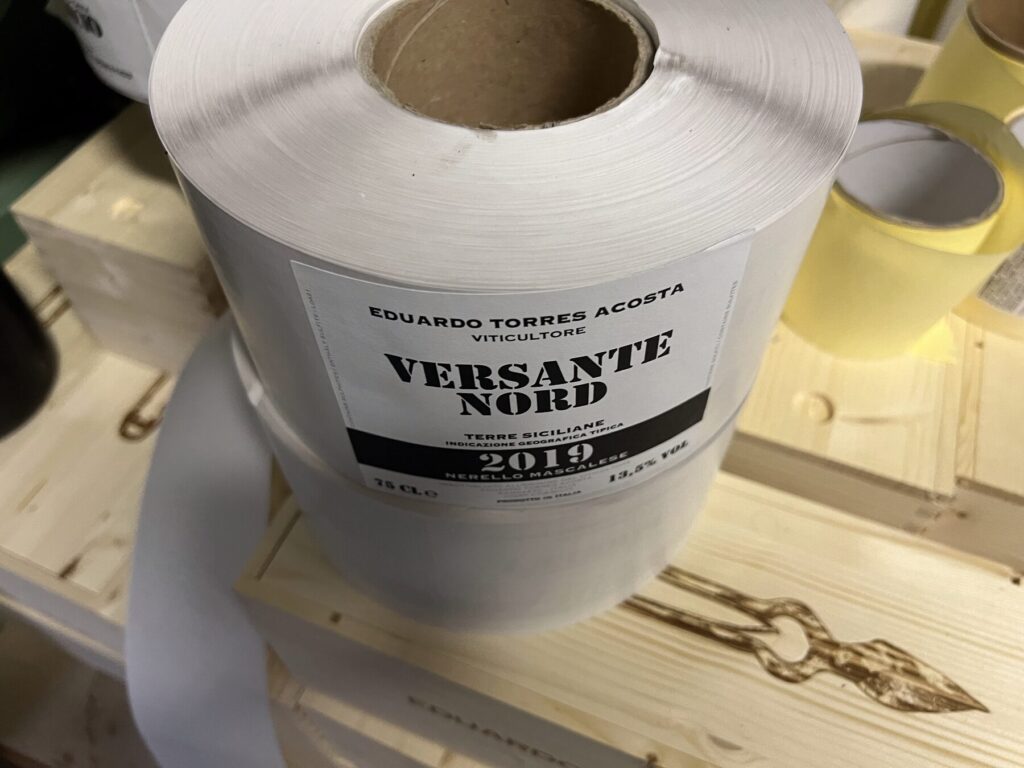
Versante Nord labels in the Eduardo Torres Acosta cellar
Versante Nord labels waiting in the cellar. Photo: Grape Collective.

For two years now I have also made a wine from this same area, but from a soil that is not volcanic, and you can see the difference between the two. The vineyard is near Castiglione at 700 meters, on a sandstone soil with some quartz, very similar to what you find in the Faro zone. That Nerello resembles Faro’s Nerello more than it does the volcanic one, even though the zone is the same. It is different from the Nerello of the volcanic soils. In the past, around Linguaglossa, one part was sandstone and one part volcanic, and everything was blended together. Nerello adapts to other places too. It used to be planted across Sicily, including around Marsala and Trapani.

What are your hopes for Etna’s future?

That we keep the territory as it is, and the wines with it. Since I arrived I have learned a great deal, and I think the more years that pass, the more you learn, watching each vintage. Every vintage since I got here has been different. With that experience, I think we will do even better. That is my ambition. I also hope the old vineyards are respected and that people keep building and maintaining the terraces. And I believe the people here, the local people, have always been important, and will keep being important for the viticulture and for the territory. When I arrived in 2013, the land was already better cared for than it had been, and over the years the roads have been improved, the local people have begun to work more, and that has brought more life and more movement. It matters, for this place and for us, that this growth continues, but only up to a point, because the land is what it is.

Originally interviewed by Christopher Barnes for Grape Collective.
Contact

Randazzo / Linguaglossa area, north slope, Etna, Sicily, Italy

390366486469

Eduardo Torres Acosta belongs to the generation that turned Mount Etna from an afterthought into one of Italy’s most closely watched wine regions, and he got there the way many of Etna’s best growers did: from somewhere else. He grew up on Tenerife, in the Canary Islands, making bulk wine with his father and grandfather on the family’s small plot. He studied agricultural engineering, then oenology, and in 2012 a friend suggested he try a harvest in Sicily. He came for one vintage, saw Etna, and stayed.

That immigrant’s eye matters. Etna in the early 2000s was a region in retreat. Old terraced vineyards had been abandoned because the grapes were worth almost nothing, and the people who saw what was still standing there, ungrafted old vines, mixed field blends, alberello training on chestnut stakes, tended to be outsiders: Andrea Franchetti, Frank Cornelissen, Marco de Grazia. Torres Acosta arrived a decade later, worked with Arianna Occhipinti and then as an oenologist at Passopisciaro, and learned the mountain contrada by contrada. What he recognized on Etna was something he already knew from home: volcanic soil, high altitude, hand labor on terraces, the palmento, and the pine-and-chestnut carpentry of a pre-industrial cellar. He is less a foreigner adapting to Etna than a volcanic islander finding a second island.

The natural wine part matters just as much. He farms without recipes, rents and buys old parcels rather than clearing and replanting them, keeps the olive and cherry trees standing among the vines, maintains the dry-stone walls, and replants with massal selections taken from the vines already in the ground. In the cellar he accompanies the fermentation rather than directing it. Etna’s revival could easily have become a land rush for prestige. Growers like Torres Acosta are the reason it also became a restoration.

Eduardo, how did you end up on Etna?

I arrived in Sicily in 2012. I am originally from the Canary Islands. First I studied agricultural engineering, then oenology. At home I worked with my parents and my grandfather, and we made wine, bulk wine. While I was studying oenology, a friend, the producer Roberto Santana of Envínate, suggested I come to Sicily, to Arianna Occhipinti. I stayed for the 2012 harvest, and that is when I met Etna.

From that year on, I wanted to come back and make a vintage here, to get to know the terroir and the varieties and to look for the things Etna and the Canary Islands have in common, because both are volcanic. So in 2013 I started looking for a winery where I could work a harvest, and Passopisciaro, Andrea Franchetti’s estate, offered me a job as oenologist that year. I started looking for vines to farm and learning as much as I could. With him I learned a great deal about the contrade and the different vineyards, and that is why I am still here.

What was it that pulled you in?

Etna itself. The volcano, which is still active. The soil. The chance to farm at high altitude, in small parcels.

You can go from 500 meters to 1,000 meters in ten or twenty minutes by car, and you can feel the difference between one zone and another: different microclimates, different rainfall, different wind, different everything. I like working vineyards in several zones, because each vineyard expresses a different idea. In larger, flatter regions you don’t find those differences.

Why do you think Etna attracted people from outside, and what was the region like when they arrived?

Part of it is simply that Etna is a place people come to. It is the Mediterranean: there is the sea, the sun, the beautiful weather. And then this particular corner of Sicily has the volcano.

Think of the people who came around 2001, Frank Cornelissen, Marco de Grazia, Andrea Franchetti. None of them are originally from Sicily. It was a depressed area then. There were established wineries, Benanti, and Calabretta up in the north, but there was no movement. The land had been abandoned, because grapes were worth nothing. So when people from the wine world arrived and found this soil, these indigenous varieties, these old vines and this traditional way of growing them, they fell in love with the place. That is what happened to me when I got here in 2012. I wanted to make wine here immediately, however small the job, because what interested me was getting to know a volcanic terroir like the one I came from.

What did you recognize from the Canary Islands?

The vineyard has always been the thing that ties it all together, and here it sits in a spectacular place with a very particular soil. In the Canary Islands the volcanic soil changes enormously depending on where you are, and it is the same here: soils that look related but are completely different from one another.

I was also drawn by the beauty of the place and by the polyculture, the fact that there are many other plants among the vines, unlike so much of Italy, where you find monoculture.

And the techniques mattered to me. The old palmento exists in the Canary Islands too, and the system is more or less the same. The training system, the alberello, is something I have really only seen here, in Etna and elsewhere in Sicily, with old vines trained to a chestnut stake. You only find that chestnut stake here on Etna. There are other places, Noto for example, with their own traditional systems, but the alberello caught my attention.

The main difference is that in the Canary Islands the system is more archaic, and here it is more professional. You see it in the old palmento: there is the window where the grapes come in, and then the work happens level by level. The upper part is where the grapes arrive and are trodden by foot, below that is the old press, and below that the aging. I think you can see the French influence, and the influence of northern Italy, in how it was built. It was more modern than what I knew. The Canary Islands were Portuguese, Genoese and Spanish in turn, and that influenced how we make wine, but there we use parts of the pine tree, while on Etna the palmento is built with volcanic stone.

Talk about the terroir of the north slope, where you work.

Our part of the north runs roughly between Randazzo and Linguaglossa. You have to understand that the north side of Etna is a kind of channel, and the air that moves through it changes everything, depending on which direction it comes from. Normally the wind comes from the west. When it comes from the southeast it is a warmer wind.

The soils were created over a very long time, millions of years and many eruptions. Some come from lava flows, and some from pyroclastic eruptions, where the volcanic material was carried by the wind and covered a whole part of the territory. That covered land is what we can farm. Where the lava flows are, it is stone, and you can’t cultivate there at all. Near those flows people gathered the stones and built the terraces.

All of this changes depending on the zone. In some places the soils are very fine and deep, and they give wines that are more floral, more fruity, a little broader. As you climb, you find soils with much more skeleton, more stone, and those wines are more direct, more spicy. It also depends a lot on the altitude. Our lowest vines are at 550 to 600 meters, and there the Nerello skins are a bit thicker and the tannin is more direct. As you go up, the skins are finer and the wines gain in finesse and elegance. That difference in altitude and in soil is what makes the terroirs so different in the end, even though it is always volcanic.

You farm organically. Was that a decision you made when you arrived, or something you brought with you?

I brought it with me. When I worked in the Canary Islands, in the traditional way, we were always essentially an organic culture.

When I arrived on Etna it was the same idea: what you do in one place, you cannot do in another. We work in several different vineyards, in different zones, and each one changes the way you farm it. For me the first thing is to respect the varieties that are already there. Over these years we have recovered the old vines I was able to rent, we bought two vineyards and we planted a new one. In all of these old vineyards we kept the varieties that were growing in them. Where vines were missing, we did a massal selection and planted cuttings from the same plants, so we have the same clones and the same varieties as the old vines around them. For me that matters: respecting the tradition, and respecting the soils.

It also means keeping the dry-stone walls, farming in a way that is sustainable for the environment, and leaving things alone. If there is an olive tree, keep the olive tree. If there are cherry trees in the middle of the vineyard, keep the cherry trees. Keep it as a farm, the way it was farmed here before. I think this diversity, this whole ecology, is important for the product we make.

What is your philosophy in the vineyard and in the cellar?

Respect what you find in the vineyard and reproduce it: keep the varieties, keep the clones, replace what is missing, respect the old vines. Then bring the fruit into the cellar and simply accompany the fermentation. In general we don’t intervene, because what arrives is good enough.

You also have to understand that the climate in Sicily is very good. Viticulture here is simple, at least on the north side. The east side is more complicated, because it is more humid. The north is well ventilated: last year we did almost nothing beyond a sulfur treatment. On the east side we had to treat more.

That is what I mean when I say the vineyards change, and that they change the wine you make. I don’t do the same thing in a vineyard at 500 meters that I do at Nave, which is at 1,000 to 1,100 meters. I do different things, because I want to interpret each vineyard and put what it tells me into the wine.

Why does the alberello matter so much to you?

The alberello is a traditional system that has been used here for many generations. It is important for the landscape, and it is important for the ecology of the place: the chestnut stakes come from the woods around Etna, and we take them and use them in the vineyard.

The practical reason is that we don’t have large expanses of land on Etna. We have terraces, and everything was once done by hand. The alberello was the simplest way to keep the canopy ventilated and in the sun. On smaller terraces you could arrange the vines and still get in to work them.

It is a lot of hand work, but the traditional planting, 1.2 by 1.2 meters, gives you a lot of vines. In the 1800s and the early 1900s, when the wine trade here was at its height, almost everything was planted to alberello, and it was planted for quantity, because the growers and the owners wanted volume of must to sell. That is why you find big palmenti all the way from the lowest part of the slope up to 1,100 meters. So the alberello is a system that can produce quantity. You can regulate the crop depending on how much you leave, and the more you leave, the more vegetation you get. It is a beautiful way to grow vines, but you have to know how to work it.

And the palmento? Does it still matter?

It is wonderful to find them here, because I don’t think you find them in many other places anymore. There are still farmers who have their vineyard and their palmento. I know a producer, now making his own wine with his family, a local family, who used to make bulk wine, and their palmento was shared between three families. They would agree among themselves on who brought in their grapes first, second and third, each with a short window to use it.

If you look at how it was set up, with no machinery at all, it was very well thought out. In those days there were no pumps, nothing. Everything was manual, so they built on the slope and worked with the levels: the must went down into the vats, and then down again to the pressing below.

It is beautiful to have that history and to keep it. The same goes for the old vineyards. We have to respect them, not destroy them to make big terraces.

Nerello Mascalese is the great grape here. What does it mean to you?

When I arrived I got to know Nerello Mascalese, which is the queen of the north slope. If you go to another part of Etna, the east side, you find a lot of Carricante, the white grape, and the same is true in the south, where there is more sun.

When I came to Sicily and discovered Etna, Nerello Mascalese was one of the reasons I wanted to stay here, farm vines and make wine. When I arrived on the north side, I would say 90 to 95% of the old vineyards were Nerello: 85 or 90% Nerello, mixed in with other varieties, including white grapes, all planted together.

For me it is a beautiful variety, with a long cycle and a good deal of resistance, in the way it ripens and in its skins. I start picking Nerello in the lower zone at the end of September and finish in the highest part at the end of October. That is almost a month, with one variety, which tells you how much the altitude shapes it. But it always gives the wine a character that I sometimes find similar to certain varieties in the Canary Islands, and I think that comes from the volcanic soil.

For two years now I have also made a wine from this same area, but from a soil that is not volcanic, and you can see the difference between the two. The vineyard is near Castiglione at 700 meters, on a sandstone soil with some quartz, very similar to what you find in the Faro zone. That Nerello resembles Faro’s Nerello more than it does the volcanic one, even though the zone is the same. It is different from the Nerello of the volcanic soils. In the past, around Linguaglossa, one part was sandstone and one part volcanic, and everything was blended together.

Nerello adapts to other places too. It used to be planted across Sicily, including around Marsala and Trapani.

What are your hopes for Etna’s future?

That we keep the territory as it is, and the wines with it. Since I arrived I have learned a great deal, and I think the more years that pass, the more you learn, watching each vintage. Every vintage since I got here has been different. With that experience, I think we will do even better. That is my ambition.

I also hope the old vineyards are respected and that people keep building and maintaining the terraces.

And I believe the people here, the local people, have always been important, and will keep being important for the viticulture and for the territory. When I arrived in 2013, the land was already better cared for than it had been, and over the years the roads have been improved, the local people have begun to work more, and that has brought more life and more movement. It matters, for this place and for us, that this growth continues, but only up to a point, because the land is what it is.