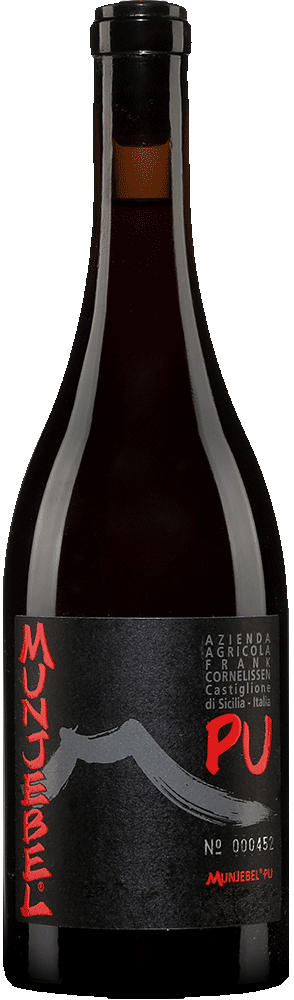
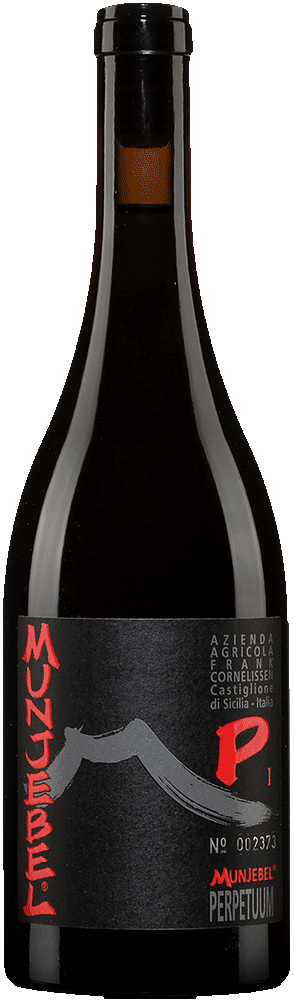
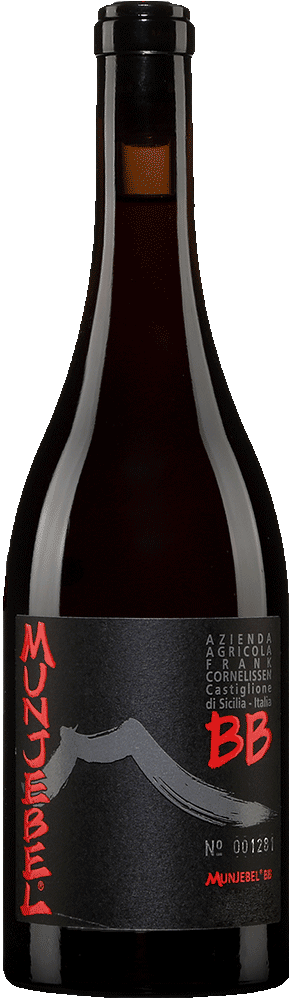
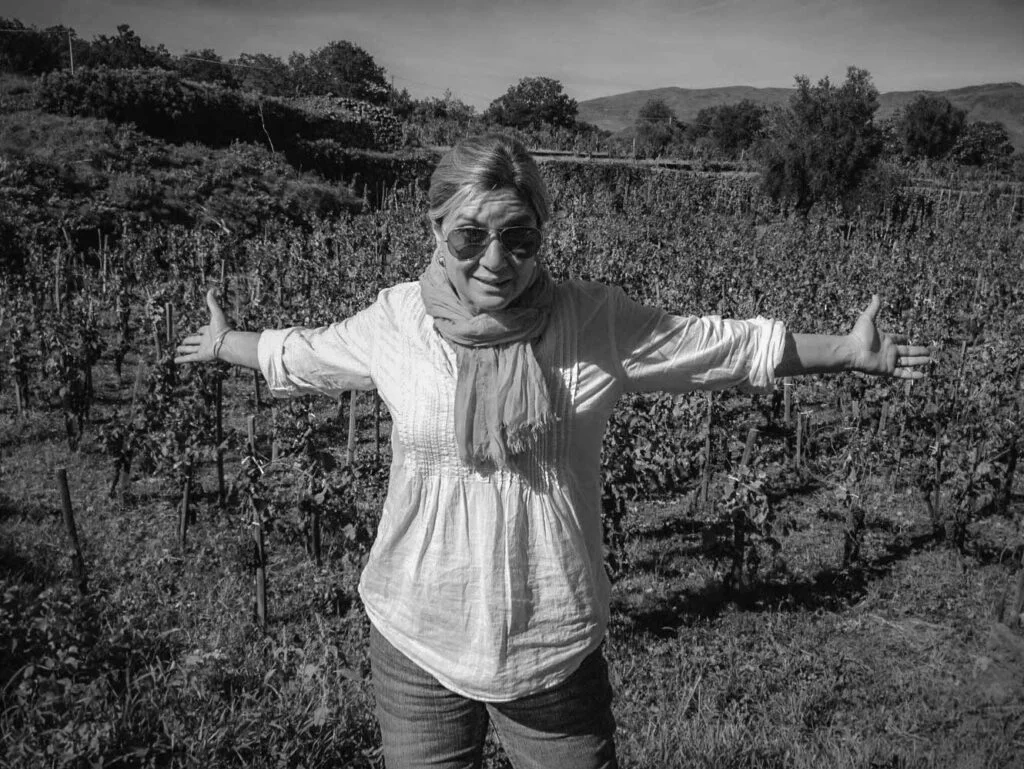
Frank Cornelissen is an Etna winemaking pioneer whose work has garnered significant attention in the world of natural wine. Born in Belgium, Cornelissen made a dramatic shift from his previous career in the business side of the wine world to immerse himself in the art of winemaking. He had no formal training as a winemaker when he decided to move to Mount Etna to pursue his desire to develop the sensation of ‘liquified rock’. He went on to produce his first wine in 2001 when he started with only 0.40 hectares of ungrafted, high elevation vines.
Cornelissen operates with a philosophy rooted in minimal intervention. His methods are emblematic of natural wine practices—rejecting the use of commercial yeasts and additives with the intent of allowing the grapes to best manifest themselves and their terroir. This philosophy has led to the creation of wines that are often described as raw and expressive of their volcanic origin.
Cornelissen’s vineyards are situated on the northern slopes of Mount Etna, where he cultivates pre-Phylloxera 140-year-old vines growing at around 3000 feet of elevation. Cornelissen’s work has not only elevated the profile of Etna wines but has also positioned him as a leading figure in the natural wine movement. His wines are celebrated for their precision, authenticity and complexity, capturing the essence of Mount Etna’s unique volcanic landscape.
Grape Collective talks to Frank Cornelissen about winemaking on Mount Etna, his philosophy of viticulture, and what makes the region so unique.
Christopher Barnes: Frank, how did you end up making wine on Mount Etna?
Frank Cornelissen: I started to make wines on Etna because of a number of coincidences, which in the end were not coincidences because there were already premises to go on Etna for a number of reasons. First one was, I would say, the Etna is the island in the island, which has a climate of its own, but people do not understand when they come to Sicily that they come to Etna and can go skiing up until the end of March. So that is difficult to understand for people when they hear Sicily.
So yes, Etna is in Sicily and we do work in Sicily, but we are on Etna, which is completely a different ballgame. And the same for wine. It is a completely different scenario with wine. And so the wine of Etna, it’s true that we are in Sicily, but we have a fragrance, a subtlety, an attention in the wines and an elegance, if I can call it that way without talking negatively of the rest of Sicily about elegance because there is great elegance in Cerasuolo di Vittoria, but Etna has something that creates something magical.
And the magical is not something extreme. It’s the balance. Etna has a balance because of the water. Even if it’s dry, it’s not excessively dry. There’s always some humidity. The territory, the geology, the incredible variety of geology. So yes, Etna is something very, very special in the Mediterranean and I would say it comes to its equals even in the upper northern side of the great winemaking areas, even in Burgundy, although it always will have its generosity and its specialty in having Mediterranean wines with depth and also density, which is not always the case in the northern areas. So it’s a very special area.
Talk a little bit about the terroir in Etna. What is special about it?
Etna is special regarding geology and terroir. Well, terroir is not just geology. So if we go to Etna, it’s special in terroir because it goes beyond geology. It is a geological matter, which is very complex because of the lava flows, the explosions, the different components of every flow. We have a geological explosion and you have lava flows, which have different components, minerally. And then there is also the terroir sense of, I would say, the environment, the influence of weather, which is different in the northern valley, compared to the eastern side, compared to the southern side.
So there are a lot of aspects which make Etna, I would say, an extremely interesting and appealing winemaking area for great wines because it’s also very complex and, at moments, also complicated to understand. This makes it an incredibly intriguing area, not only from a winemaking point of view for me, but also and especially for the consumer because every vintage is very different. It needs to be interpreted. And so although we are also at the verge of this interpretation, there are a lot of things to understand and to know, but we’ve got an incredible future for this, just because we are only at the verge of understanding all those small details, intermingled makes it a very complex area.
And I think one thing that’s interesting about Etna is, if you compare it to other wine regions, such as Piedmont, which is all monoculture, you have this great diversity of plant life and of different types of agriculture on Etna.
Piemonte was actually my reference point in the search for a great winemaking area. And so when I arrived here on Etna, I found a lot of the values of Piemonte, the artisanal part, the rustic part and this link from producer to soil, to territory. I found it in a very, very close way.
Now, where Piemonte was the end of the ‘90s, it was already evolving into something very pristine, big cellars, and a lot of changes for the better also, economically, and also for the better for the wines. The wines were more refined in Piemonte.
And so when I arrived here, I found Piemonte from the ‘80s, I would say, first of the ‘80s, the ‘70s. And I thought, “Wow, I found a new Piemonte,” but on the other hand, I also am little bit guilty of, partially me and I think also Marco de Grazia, because I think both of us, we are very much romantic winemakers. And I think we loved what we have seen in Piemonte. We live here today, but we also understand, intellectually, that this will not be the same in 20 or 30 years again, just like in Piemonte.
It’s like a deja vu on what I’ve seen here and what I absolutely love. What we have here is an unpolished jewel and a pure diamond, a raw diamond, and we are gradually polishing it, which means that we are also the cause of a new era of winemaking on Etna. It puts you in a difficult position. So yes, I like that, but also, no, I don’t like that. I don’t want Etna to become a new Piemonte, although I would like it to become a new Piemonte. So it’s a very difficult complex situation, intellectually, what is going on on Etna today. I love it and maybe I wouldn’t like it to happen. So it’s a complex situation.
And when you arrived here, there were very few winemakers making bottled wines on Etna. Things have changed radically over the last 10 years. How would you describe those changes? Are they all positive or are there some negative changes as well?
When I arrived, there were very few wineries bottling their wines. And so it was strange, in a way, because when you go and drink wines, you love them with the food. And so you cannot go to a winery, just pull out five liters of wine, bring it to a restaurant and pour it from a can or a plastic bottle. That is not really a cultural value to a winemaking area. So what I loved seeing on Etna was this evolution to bottle more and more of the wines, which were pristine, which were made according to the contrada, which means a lieu dit on a larger area. And so you have the precision, the attention to detail, which was developed gradually, little by little. Benanti was starting to do that.
And so I really like that, as a wine passionate person in the beginning, and then afterwards also as a producer. So that kind of evolution is, I think, extremely positive. I’m not saying something negative, but I would say a consideration is to see a lot of people talking about contradas or high-precision winemaking without having the real tools to do that, neither the cultural baggage and luggage to understand which are the great winemaking contradas to make single-vineyard wines and the lesser wines to put into assembling the wines.
I think we’re very young and we need to learn. We’ll make many mistakes, but if I go back into my journeys in Piemonte in the ‘70s and ‘80s, I think we have at least as much quality in hand and I would love to see this developed in an absolutely great way and a profound way for the future. And I’m sure we will do that because we have more information, and I think we are more sensitive today than we were 40 years ago, in terms of sensitivity to terroir and wine and everything else. So I believe Etna is something very, very positive for the future.
And Frank, when you arrived here, how did you look at the landscape of traditional winemaking on Etna? Did you look at traditional winemaking and say, “I’m going to be a traditional winemaker,” or, “I’m going to do things differently?” How did you take the scope of what had happened before and make decisions on how you were going to make wines going forward?
When I arrived, I was very much, I would say, convinced with my own principles of winemaking, which means nothing added, the absolutely pure, natural wine, which was … It’s used also as a statement many times, like liquid rock. Liquid rock was something which is very important for me because it’s a provocation as a concept. Liquid rock means, especially on Etna, the essence of Mother Earth in wine terms.
So that being said, my first wines were highly oxidative. And so they went beyond the fruit, which was obviously a provocation. I started out with a very strong personal concept of a wine, which gradually changed into, I would say, a balanced concept of what Etna is. So my first wines from 2001 to 2005 and ‘06 were very much me, Frank Cornelissen, and then the wines afterwards were very much Etna, gradually, into various forms and subtleties.
And so I’m very happy of that evolution because I’m happy that, myself, I evolved. I’m not stuck in some kind of pre-concept about something that was in my mind and I’ve kept that. I’ve evolved together with an area, with, obviously, my techniques. And so I think, after 10 years, 12 years, I gradually made more harmonious wines, balanced wines, which represent Etna much more than myself.
That is something very important. And I’m very happy with that evolution. And so when I drink, for example, the Etna 2020 Munjebel classic, I think this is a great Etna wine where I’m accompanying the wine to what the wine represents of the area, but this is not a wine of Frank Cornelissen, this is a wine from Etna. And that is something I’ve wanted to do, but I was not able to do. After 20 years, I’m able to do that. And so I’m very happy to represent Etna rather than myself.
Talk a little bit about your philosophy of viticulture. How do you think about growing the grapes and has that evolved?
The growing of the grapes hasn’t evolved that much. I started with a great respect for land and for Mother Nature. And so that hasn’t changed, let’s say, fundamentally, it didn’t. So the details are the ones that change, obviously, the big picture because the details are important in agriculture. And so instead of, again, using pre-concepts of what intellectually seems right, but then on the land, were not really applicable and were interesting to understand.
Eventually, after three or four years here, which was relatively fast, I understood that the best mix is to look at what traditionally has been done, and you take away the excess at one end. I’ve taken away my excess, in terms of agriculture and pushing things beyond limits many times. I’m not saying within limits, but really beyond. Taking away that and I’ve come to a balance between what was traditionally being used and using scientific methods of measuring.
Today, we cultivate basically organic at new levels or the modern levels of what will become the organic level of using, for example, the sulfur and copper sulfate. And so we are very respectful and also at the level of new levels of what European certifications require in terms of biodynamic and organic farming. I’d like to be ahead of what will become a reference point, in terms of not only certification, but I want to be ahead of time. And that is something I’ve always liked, technically, but also philosophically.
And Frank, what is your opinion on the use of alberello?
The alberello system of training is a great system in planting, in general in the south, in the Mediterranean, because when we think back on 60, 70, well, more than 70 years ago, the cost of land was basically much more expensive than the cost of labor. So 70 years ago, it was more important to use an alberello, where you can plant high density. Today, we have a different situation. So we’re 2022 and we face a different situation where the labor is much more expensive compared to the land, except for Burgundy.
So which is better? I would say, eventually, if you look at an alberello made in a classic way, high density or high terraces, which has a historical value because you couldn’t do anything else. So the issue is it’s not the training system that defines the quality. The quality means how many grapes, how much fruit is there is per vine. My recipe is great on vineyards, whatever the training system is, low yields, old vines. That is the real recipe for great wines.
What is your opinion on palmento, this historical vehicle for making wine that has been outlawed by the EU? There are some people who are in favor of bringing it back and there are others who feel that it’s outdated and unnecessary.
Well, palmento, as a concept of a winery, is, I think, mechanical perfection. It uses gravity. I think it’s absolutely genius, mechanically. What I question is whether that palmento is always the best way to make a wine because a palmento was made in a period where the wine was going into a volume, call it a barrel. There are a few, I would say, physical mechanical issues to handle with the palmento.
If somebody would love to make a wine in a palmento, they can do it perfectly fine. So yes, I like it. I really do, but it takes a lot of cleaning. I prefer not to, in my case, because a palmento has a number of things, like the pressing is less precise because it takes bigger masses. I do love wine made in a palmento. I think it’s heritage. I think it’s historical and I think it’s of very high value of what Etna represents. I’ve made other decisions because I like to make wines with a bit more precision.
Can you talk a little bit about Nerello Mascalese and what you think the potential is of this grape? Because we have the volcano, which is obviously the terroir, and the grape is one of the other key pieces to making a great wine.
Nerello Mascalese is, for me, the prime varietal of Etna. When you look at the color also, it’s not very dark. It’s like, when you look at an art piece and a painting and it’s not really very expressive, you have to go and search for the profoundness in the light, in the profoundness, in the painting. It’s the same thing with Nerello.
Nerello is something more, I would say, generous. It grasps you. Nerello Mascalese, it’s not your favorite variety maybe, but there’s some fruit and it’s intriguing, it’s not absolutely upfront, and so you appreciate it. Nerello has something a bit more generous. It has a Mediterranean touch, which Barolo doesn’t have. And I think it’s very intriguing, but it’s very profound and it has an incredible stretch also in the aging, which I really absolutely like.
That’s why I do believe that the Nebbiolo, when it’s right in the great vintages and in the great expressions, it goes beyond Pinot because it goes beyond the first stretch. Anyway, Marco may be able to shoot me, but I think a Nerello is a great gateway to the great Nebbiolo of the world.
Frank, what are your hopes for the future of Etna?
Well, it’s a great question. Today, when we’ve got a war between Russia and Ukraine going on, my hopes for the future of Etna is first of all, stop making wars. What I would love is to see the world less angry, especially, and more gentle and comprehensive towards other people from other cultures because that is basically what I think wine is. Wine is the absolute essence of a gathering of cultures and of human beings, of people liking each other and making a gathering.
If you go back to Etna specifically, I see a very bright future for Etna because we have all the qualities we have. We have, I think also, incredibly motivated and also dynamic people and estates starting here. So when I was here 20 years ago, when there were about, let’s say, 20, 30 estates around Etna bottling, today, there are about 200 estates bottling.
This is an incredible evolution, which I absolutely enjoy. I love that. When I taste this and I go back to the great references of the old days, I think we’ve got an incredible jewel in our hand. And I think, even with terrible times like today, I think we will get over that. And I see this positively in the future. We just have to believe in what we do, just go our own way, work together, like we did so far, and we will get there. I’m not saying easily. It takes time, it takes dedication. You have to just go for it, but I see this very, very positively.