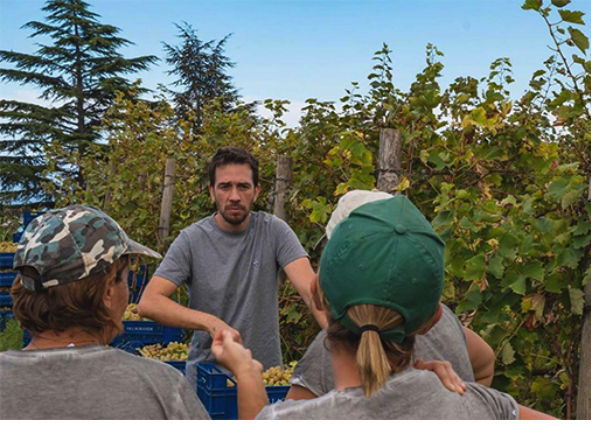
Mount Etna is (literally) exploding. Sorry for the tired pun, but simply put Etna is one of the most active and popular volcanoes in the world. Etna’s popularity is due in part to its scenic and awesome eruptions shooting radiant lava, clouds of smoke, and bits of inner-Earth into the stratosphere. Etna is also very “hot” due to the delicious wines produced on the volcano. Okay, so I am not so sorry for the pun use!
Both Etna Rosso (red) and Etna Bianco (white) are spectacular and deserve high praise. Ask The New York Times’s Wine Critic Eric Asimov who has this to say about Etna Rosso: “No grape more than nerello mascalese illustrates the profound changes that have transformed the world of wine in the last 25 years.” And with regards to Etna Bianco: “When grown in the right soils, under proper conditions, carricante makes one of Italy’s most compelling white wines, wholly different from any other. It’s a wine understood not so much for its fruitiness as for its savory elements, which is true of some of the world’s great whites.”
Few folks know Mount Etna like Salvo Foti. Born, raised, and currently living on Etna, in the town of Milo, Salvo lives to protect Etna, her traditions and people. A true Etneo! Throughout the years, Salvo has played an essential role in the recognition of Mount Etna wine, acting as a consultant for many wineries (Benanti, Vini Biondi, etc) that are now famous on the volcano.
 Salvo Foti helped reestablish “I Vigneri” to protect and preserve the Mount Etna specific customs and traditions that take place in vineyards, in the cellars and throughout the winemaking process.
Upon visiting Salvo, which I did back in 2018, he makes sure to set the tone quickly — dismissing his wines being labeled as “Natural Wines” or “Heroic Wines,” rather offering the term “Human Wines.” Salvo is inspired to cultivate and nourish a culture of winemaking that is respectfully to human nature and tradition. After all, wine is not made without some human involvement.
In my interview with Salvo, he explains the human side of winemaking on Mount Etna.
Marco Salerno: Please tell us what Etna was like as a wine growing region when you were growing up.
Salvo Foti: Very, very different. Fifty years on Etna, especially in the higher areas, there was rural agriculture, made up of many small farms, vineyards, and orchards. Almost everything that was consumed was produced in the countryside by many farmers who took care of the whole territory. Bartering was widespread. The wine was almost all produced in the palmenti [stone buildings for fermenting wine] and sold in bulk to the many consumers who went up to Mount Etna at the weekend from the coast to buy wine and the many agricultural products produced on the volcano. Low-income viticulture, but genuine, sincere and truly respectful of the territory.
There are a few sides to Mt. Etna. Could you please tell us about the different areas on Mt. Etna? Why is Milo so special?
The Etnean territory, for its particular truncated-conical conformation, for its nature (it is a large mountain and an active volcano) for its altitude (over 3,000 meters), for its particular climate, unique in the world (it is a “North” in the South) and due to its geology (different lava flows), it expresses very different pedoclimatic environments, which have always influenced the local flora and fauna (and consequently also the people by Homo Ætneus). These important differences and biodiversity, in the case of viticulture, have determined the selection and cultivation of native vines specific to the Etna area, almost exclusively cultivated in this territory of origin and rarely exported, if not recently, to the rest of Sicily. The indigenous Etna vines, which we use to produce our wines, such as the white Carricante, the white Minnella, the red Minnella, the red Nerello Mascalese and the red Nerello Cappuccio, as well as being grown in their territories of selection and excellence, that is in their specific slopes and altitudes of the volcano, they are raised exclusively with the ancient system of the Etna sapling (Aegean sapling) by Etna winegrowers and with ancient and traditional production systems specific to this territory with planting density of 7,000-9,000 vines per hectare, on terraces made with dry lava stone walls, in order to contain the volcanic soil.
A clarification should be made regarding the particular Etna soils. Obviously these are volcanic sands, more or less fine, of different lava flows and ages. So the soils on Etna differ significantly between one area and another of the volcano. These are soils produced by the disintegration of lava flows with variable age and presence of minerals and not at all homogeneous.
Depending on the slope, it is also possible to find in the soil an abundant presence of ashes and lapilli that fall at each lava flow (so it can often happen during the year) rich in particular and unique mineral components. So these are terrains that we can define as virgin, primordial, visceral and in constant change. Let’s remember that Etna is a perpetually active volcano, which never stops. The presence of these lapilli [unconsolidated volcanic fragment] on the eastern side of Etna, is significant, especially in the area of ??the municipality of Milo around 700-900 meters above sea level, where they play a particular role in the production of white wines from Carricante. This vine, more than others, benefits from the olivine, a particular mineral compounds contained in the volcanic soils, rich in silica, iron, magnesium and potassium, which greatly enhance the minerality of Etna Bianco Superiore, which can only be produced in the municipality of Milo.
The Milo area is also characterized by a particular climate, colder and more humid, ideal for the Carricante vine, which in this area was selected by the Etna winegrowers.
 What is a Palmento and why is it special to winemaking on Mt. Etna?
On Etna, the agricultural landscape was characterized by countless, beautiful and ancient manor houses, now mostly abandoned, owned by peasants, bourgeois and nobles. Each vineyard was equipped with a home for the owner’s family and, invariably, for the palmento, that is the winemaking cellar, for the transformation of the grapes produced in its own vineyard. The palmento with its terraced vineyards, narrow streets, dry stone walls, all built in lava stone, was surprisingly harmonized with the Etnean environment.
Even today it is possible to see on Etna palmenti ranging from the essential to the sumptuous with very variable vinification capacities: from a few to thousands of hectoliters. In addition to the use of lava stone, a feature of the manufacture of Etna palmento is that it is built in such a way as to use the force of gravity in winemaking. The natural slope and rugged orography of the Etna area have been wisely exploited, becoming a resource for winemaking: the crushing area, the fermentation vats, the pressing area and the cellar are located at different and sloping altitudes. Between the end of the 1800s and the beginning of the 1900s, about 100 million liters of wine were produced in the Etna area: an enormous quantity of grapes transformed into wine using exclusively the palmenti.
The palmenti on Etna for the production of wines were used until the 1960s, obviously with some modernizations and technical changes. With the arrival of electricity, several manual operations were replaced using new equipment, but essentially the system continued to be the same as always. In 1997, with the strict and indiscriminate application of EU laws on food hygiene and safety at work, the palmenti of Etna were banned and definitively closed. This favored the industrial production of wine to the detriment of crafts and small peasant production.
The Etnean winemaker found himself, forcibly, passing from a wine producer to a grape producer. Having neither the financial means nor the time to adapt, Etnean winemakers gave up their most important income: that is, the sale of wine. The consequence was the drastic abandonment of thousands of palmenti and Etna vineyards and their irreversible destruction. Only very few producers, in disagreement with the laws, continue to use the palmento to make their wine, obviously considered illegal! The lack of exceptions, in the application of community laws, designed to allow, in a gradual and financially sustainable way, the adaptation of the Etna palmenti, has inevitably determined their degradation, the abandonment of large areas of the Etna territory and the loss of specialized winemaking workforce.
The adaptation of the Etna Palmenti to winemaking is now necessary and indispensable, if you do not want to completely lose the real estate and human assets that remain. New techniques, greater knowledge and a more conscious way of thinking allow us today to find solutions that integrate and harmonize the old with the new. The transition must be gradual, the changes not destructive but integrative and complementary.
THE ETNA PALMENTI ARE TO ETNEI WINES LIKE THE AMPHORES TO GEORGIAN WINES!
Recovering and using the ancient palmenti, in addition to maintaining, conserving and safeguarding the territory and all that it contains and represents, also means recovering, using and making productive the ancient winemaking techniques that we know today are fundamental in excellent wine production.
A TRUE AND ORIGINAL ETNEO WINE SHOULD BE PRODUCED IN AN ETNEO PALMENTO.
The laws must be reviewed taking into account real situations and adapting to the existing ones and looking to the future. They must be at the service of humanity, not against it or only for the benefit of a few.
 At what moment did you decide to revamp the I Vigneri association? Please explain what I Vigneri as an association means and what it strives to achieve.
The consortium of I Vigneri, which takes its name from my own company, was officially established in 2009, but since the early 2000s it begins to operate on Etna and subsequently in other suitable areas of Eastern Sicily (Noto, Vittoria, Aeolian Islands, Pantelleria).
The guiding philosophy behind the “I Vigneri” consortium is respect for man and the territory. The consortium that inspired me was founded for the first time in 1435 in Catania. It was re-founded by me with the same spirit and with the same purposes.
The consortium was set up between wineries that have in common respect for the environment, the cultivation of sapling vines, native vines, the same team of winegrowers, vine professionals, all from Etna. The common foundations are the territory and the winemaking philosophy that respects it. Our symbol, shown on the bottle that all the associated companies use, is that of I Vigneri, that is, a centennial alberello vine training method [head-trained bush vine], a symbol that dates back, like the original I Vigneri, to 1435.
The cultivation techniques we use, in the vineyards and also in the cellar, are those of the best and oldest Sicilian winemaking tradition, and Etna in particular. The alberello, a viticulture system with about 2000 years of history behind it, with a high planting density (8,000-10,000 vines per hectare), means that the winegrower must cultivate vine by vine, take care of plant by plant and therefore is not a mechanized, intensive and invasive cultivation, but respectful of the natural needs of the vine. Sapling cultivation, if carried out by experienced and sensitive winemakers, does not exploit the plant or the territory, so much so that the vines can live for hundreds of years.
A vine cultivated in this way will be so harmonized with its environment that it will give excellent grapes for the production of wine without having to be treated with chemical products and fertilizers and synthetic pesticides. The fruit ripens in the best possible conditions and in a natural way. In the cellar, when making wine, simply take care not to ruin the product obtained in the vineyard. You just need to apply some simple winemaking techniques and a lot of hygiene.
Read the full interview with Salvo at Grapecollective.com