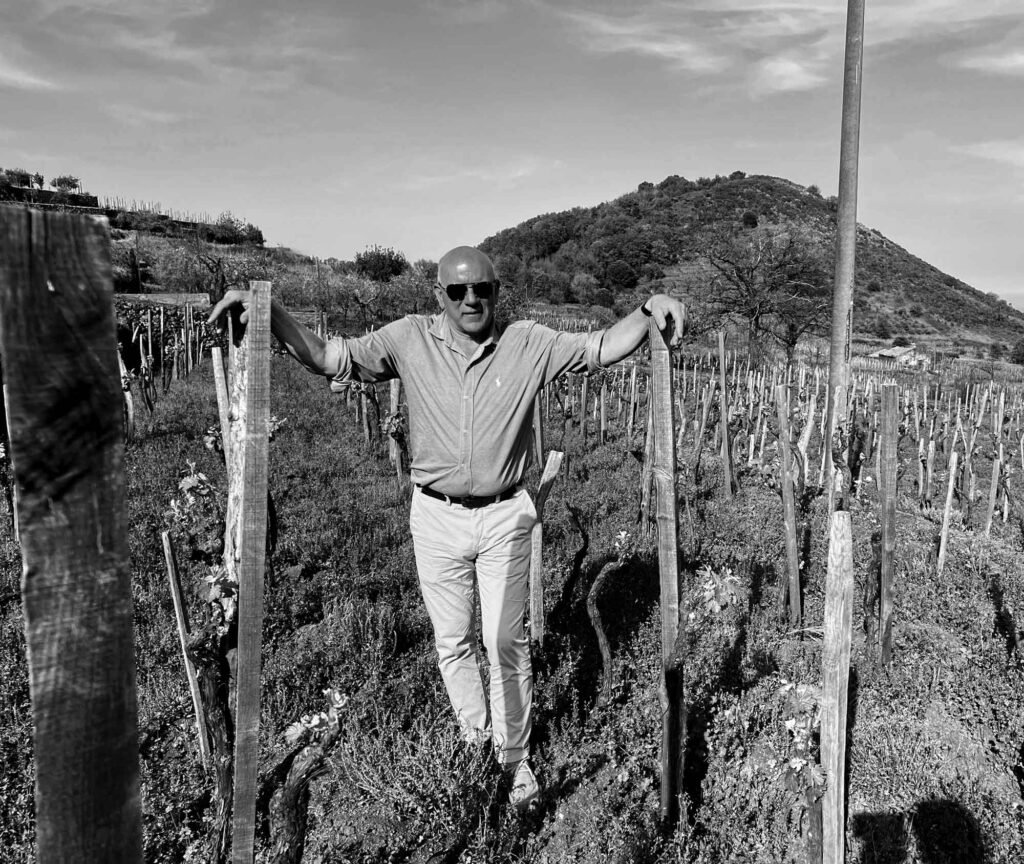
Benanti was founded in 1988 by Giuseppe Benanti, a pioneer in showcasing the exceptional potential of Etna’s indigenous grape varieties, such as Nerello Mascalese and Carricante. Today, it remains a cornerstone of Etna’s viticultural renaissance, under the stewardship of Salvino and his twin brother Antonio Benanti. Together, they have built upon their father’s vision, blending tradition with innovation to craft wines that embody the spirit of the volcano.
Salvino Benanti talks to Grape Collective about the challenges and rewards of winemaking on an active volcano.
Salvino Benanti on Winemaking at Benanti on Etna
Christopher Barnes: What is it like living on an active volcano? What is the emotional connection of the winemaker in Etna to the land, to the volcano?
Salvino Benanti: For us locals, Etna is a given. It has always been there and we have learned to not pay much attention to its eruptions. We know they are frequent, but almost harmless, and we consider them normal. Etna towers over Catania and over our lives and its presence is almost reassuring for us. It is a symbol of power and energy and reminds us that nature is strong, but also kind, and that we must accept it and respect it.
Marco de Grazia started working on Etna around 2002, fourteen years after Benanti. By then, we had already introduced single vineyard world-class wines to the world stage, like Pietra Marina and Rovittello. Benanti produced the first few vintages of Marco De Grazia’s wines before Marco “grew his own wings,” as he will confirm. I see less limits to making fine wine on Etna than elsewhere, because we have great climate, great soils, great grapes and a long tradition. The volcano is not a threat, but rather an advantage.
How old is the volcano and how active is it?
Etna is 550,000 years old and has always been very active. We have seen an increase in activity in recent years as some craters, like the Central Crater, have resumed activity very vigorously after a period of dormancy. In addition to Etna itself, there are a number of side volcanoes dotting the southern flank of Etna which are dormant. Our Monte Serra is one of them.
Talk about Etna’s winemaking history.
Etna’s winemaking history goes back a few thousand years, and originally saw vineyards being planted all the way down to the sea, but then phylloxera, emigration and poverty hampered it until the mid-1900s, when a proper appellation was introduced. Etna, like the rest of Sicily, produced mostly bulk wine until the appellation was introduced. Then a handful of quality producers, Benanti being one of them, emerged, focusing on quality products made from autochthonous grapes. From the 1980s onwards things started to change for the better, and then a second wave of investors came in the 2000s, both from Sicily and from around the world.
What is a palmento and what happened to it on Etna?
A palmento is a grape pressing and fermentation hall which exploits a number of physics-related phenomena to produce wine. Given its complexity and limited suitability to modern winemaking, it is no longer used much, but it still serves as a testimony to our long winemaking tradition.
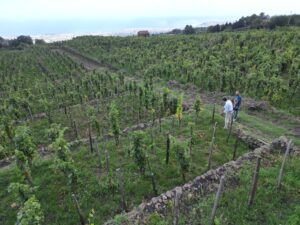
Please describe the terroir on Etna generally and your estate in particular. Frank Cornelissen calls it the island within the island.
Cornelissen is merely quoting my father Giuseppe Benanti, who was the first to coin the expression “island within the island” and its subsequent evolution “archipelago within the island,” years before Cornelissen arrived on Etna. My father’s intention was to explain that Etna is different from the rest of Sicily and, through the word “archipelago,” that Etna itself is a mosaic of different sub-terroirs. We cover all four slopes, owning five vineyards located in some of the best locations.
It is very important for us to respect tradition and only plant those grapes that best suit each area — Nerello Mascalese in the north, Carricante in the east, both grapes in the south. Our northern contradas, Calderara and Dafara Galluzzo, are both planted with Nerello Mascalese only. Calderara is a flat vineyard with stony soil, delivering richer, more generous wines, while Dafara Galluzzo sits at a higher elevation with sandier soils, delivering more restrained wines. Contrada Rinazzo, in Milo (East Etna), is planted with Carricante only — Milo being the homeland of Etna Bianco Superiore, allowing us to produce ultra-elegant, restrained, age-worthy whites there.
The southern contradas differ a lot from each other too. Monte Serra has a Mediterranean climate with young soils, resulting in low-yield, restrained wines. Cavaliere, in the southwest, has older soils and a continental climate, sitting at almost 1,000 meters above sea level, delivering powerful wines while retaining very good acidity.
The primary grapes on Etna are Nerello Mascalese and Carricante. How do they express themselves?
Nerello Mascalese is a very elegant red grape characterized by notes of small red fruit, dry flowers and graphite, with silky tannins. Individual contradas are, in my opinion, more important than the simple north versus south issue. Carricante traditionally prospers in the east and south, and has found a “luxurious” home in Milo, so much so that it has obtained a Superiore appellation there and only there. It is not an aromatic grape — it shows notes of white flowers, thyme, lemon and orange peel and, with time, flint and petrol, supported by very good acidity. We believe a lot in single-varietal, lees-aged, steel-matured Carricante.
What are your hopes for the future of winemaking on Etna?
My hope is that Etna develops into a long-term “great classic,” like Barolo or Barbaresco, winning the hearts of fine wine connoisseurs around the world. The adoption of a DOCG, with even stricter rules and a clear commitment to excellence, will help us get there. I am incredibly excited about the future and I am proud to see what Etna has become. It proves that my father Giuseppe’s vision, 36 years ago, was correct.
Originally interviewed by Christopher Barnes for Grape Collective.