
A Return to the Roots: Ruben Parera and the Natural Wine Revolution in Penedès
Christopher Barnes
There is a quiet revolution taking place in the vineyards of Penedès, the sprawling wine region that stretches from the Mediterranean coast to the foothills of Montserrat, just southwest of Barcelona. It is a revolution that looks backward as much as it looks forward — a rejection of industrial logic in favor of ancestral instinct, a turn away from the laboratory and back toward the land. And among the figures leading this movement is Ruben Parera of Finca Parera.
To understand what Parera represents, it helps to understand what came before him. Penedès is the birthplace of Cava, Spain’s most celebrated sparkling wine, and for much of the twentieth century, Cava defined the region’s identity and its economy. When the category exploded in the postwar decades, driven by a handful of large houses with global ambitions, it transformed the landscape of Penedès in ways both good and bad. The good was that Cava gave Catalonia a brand of international stature, a product that could hold its own alongside Champagne on tables around the world and deliver a taste of celebration at a democratic price.
But the industrial machine that produced Cava at scale came at a cost. Small farmers who had for generations grown grapes, made wine, and sold it from their own cellars found themselves absorbed into a system that valued volume above all else. The calculus was simple and seductive: sell your grapes to the large Cava houses, earn a reliable income, and leave the complicated business of winemaking to someone else. The land, farmed increasingly for yield, began to lose the character that had made it special in the first place.
This is the world Ruben Parera was born into. His great-grandfather made wine. His grandfather made wine. But his father, a pragmatic and forward-thinking man, recognized which way the wind was blowing and made a different choice: he would grow grapes, not make wine, and he would do it better than almost anyone. He became a pioneer of organic certification in Catalonia, farming not only vines but almonds, olives, and cherries with a rigor and integrity that was unusual for its time. It was an act of intelligence and adaptation, but it also meant that the cellar — the place where the family’s agricultural story became something you could taste — fell quiet.
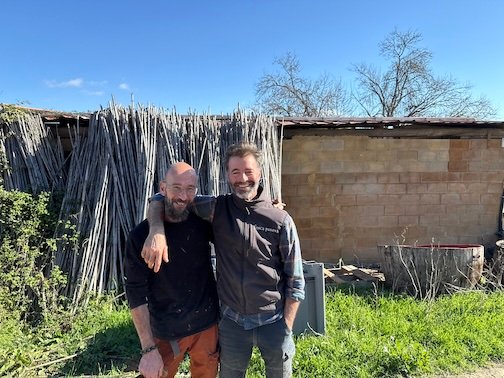
Ruben Parera relit it. Beginning with his first vintage in 1999, he set out on a journey that would take him from the technical wine he had learned at university, through a deep immersion in the natural wine culture of France — the Loire, the Jura, producers working without intervention in Andalusia and beyond — and ultimately to a philosophy that was entirely his own. Biodynamic farming, indigenous yeasts, skin contact, minimal intervention in the cellar: these became not fashionable choices but logical extensions of everything his father had taught him about respecting the land. If his father’s generation asked what organic farming could do for the earth, Parera’s question became what the earth, left more fully to its own intelligence, could do for the wine.
What makes Parera a leading light in this movement is not just the quality of what ends up in the bottle — though the wines, built on the exceptional raw material of Xarel·lo and Sumoll grown in the calcareous, high-altitude soils beneath the shadow of Montserrat, are remarkable.
Grape Collective spoke with Ruben Parera at Finca Parera, surrounded by his vineyards in Alta Penedès, about terroir, biodynamics, natural wine, and the meaning of putting your name on a bottle.
Christopher Barnes: Ruben, tell us a little bit about the history of the estate here.
Ruben Parera: This estate has deep roots in this town, which was the last town after the appellation of Penedès. I am the fourth generation of farmers, and now my father and I are the first generation to make wines together. I have already seen this estate evolve through different ideas — regenerative and biodynamic — not only in vines, but in almonds, olives, cherries, beehives, and animals. And obviously, in the wines.
And talk a little bit about the evolution of winemaking in Penedès — how we’ve gone from the idea of large-scale Cava production to natural wine.
To properly answer that, I need to take a step back in time. Before Cava, the tradition here was for every small town to have its own little cellar, its own vigneron and winemaker — often the same person. Cava brought about a big revolution in this area, because for the first time, Catalonia had a brand powerful enough to compete with Champagne across the world.
Cava is one of the best things that ever happened for the brand of Catalonia. But that revolution also had a downside for the small farmers of the towns around Penedès. Once Cava was so successful, the appetite was for volume — produce as many grapes as possible, because selling bulk grapes was more reliable than selling wine from a small town. That transformation meant the cellar was abandoned, the winemaking tradition was set aside, and the focus shifted to grape production.
My grandfather made wine and sold it. My father sold the grapes instead — it was simply smarter economically. Then comes my generation, and the younger winemakers around me, who say: I will not put my good grapes in the hands of the industry. I will take control of my family’s story and make my own wines. This new generation is more connected to the spiritual side of the land — to the history, the ancestry, the plots — than to technology or engineering. It is not easy to explain, but it is a real movement. Many young winemakers around 25 years old are now making wines from their grandparents’ old vines, reloading the line of the farmer. They come with education, training, and knowledge — but they are reaching back to their grandfathers’ time, before the Cava revolution, and making wine again from healthy, natural grapes. It is one of the most exciting things happening in Penedès right now.